Category Guide
App Store Optimization for Medical Apps: Strategy Guide
ASO strategy guide for medical apps on iOS: Apple's medical guidelines, evidence-based metadata, and keywords for professionals or patients without overclaims.
The Medical Category Landscape
Medical is one of the most rules-bound categories on the App Store. Apple holds medical apps to a higher review bar because incorrect or misleading information can cause real harm. The rules apply to your code, your privacy posture, and (importantly for ASO) your metadata. Claims that suggest diagnosis, treatment, or clinical accuracy beyond what the app actually does will fail review and can attract regulatory attention later.
For these reasons, ASO in Medical is less about creative wordplay and more about precise, defensible language. The keywords that win here are mostly job-led and audience-led, not aspirational.
Apple's review focus areas that affect ASO
Always treat Apple's App Review Guidelines as the source of truth. The medical-relevant areas to keep in mind for metadata are roughly:
| Area | What it means for ASO |
|---|---|
| Accuracy of health information | Avoid implying diagnosis or clinical certainty in title, subtitle, or keyword field unless your app is genuinely backed by that evidence. |
| Drug and dosage references | If you list specific drugs or dosages, expect deeper review. Metadata that name-drops drugs without an evidence base is risky. |
| Privacy and consent | Apps handling health data have stricter consent and disclosure rules. Don't promise unsubstantiated privacy properties in metadata. |
| Sources and credentials | For clinician-facing apps, naming the source body or guideline lineage in metadata can be a positive trust signal, if it's true. |
None of this is legal advice. Engage your own medical and legal counsel before shipping medical metadata.
Two distinct buyer audiences
Medical apps usually serve one of two audiences, and the keyword strategy differs sharply between them.
- Patient-facing apps (symptom trackers, medication reminders, condition support): the buyer is the patient or a family member. Search language is plain-English, condition-led, and outcome-led.
- Clinician-facing apps (point-of-care references, calculators, decision support): the buyer is the clinician. Search language is technical, role-led, and abbreviation-heavy.
Some apps serve both, but most should pick a primary audience for the listing and treat the other as secondary. Trying to write metadata that satisfies both usually satisfies neither.
Keyword patterns for Medical
| Keyword type | Example | Strategy |
|---|---|---|
| Condition + tracker / log | "migraine tracker", "blood pressure log" | Patient-side. High intent: the buyer names the condition. |
| Medication / regimen | "medication reminder", "pill tracker" | Patient-side. Pair with an audience or a condition. |
| Clinician + tool | "medical calculator", "point of care reference" | Clinician-side. Precise, role-led language. |
| Specialty + tool | "cardiology calculator", "anesthesia drug guide" | Clinician-side niche: a specialty and the tool it needs. |
| Audience + outcome | "diabetes log for caregivers" | Differentiates from generalist competitors. |
The measured table below shows how each of these patterns compares with "medical" on its own, for patient-side and clinician-side terms alike.
24 medical app keywords, measured in the US App Store
Measured by RespectASO on 6 October 2026. Popularity is RespectASO's estimate of how often a keyword is searched compared with others, from 1 to 100. Difficulty, from 1 to 100, says how hard the apps already on top are to pass. "In top 10 names" counts the top ten apps with the keyword in their name. How the numbers work.
| Keyword | Popularity | Difficulty | In top 10 names |
|---|---|---|---|
| Head terms | |||
| medical | 54 | 64 Hard | 5 of 10 |
| medication reminder | 33 | 51 Moderate | 3 of 10 |
| pill reminder | 50 | 50 Moderate | 8 of 10 |
| blood pressure log | 48 | 55 Moderate | 5 of 10 |
| medical calculator | 43 | 41 Moderate | 6 of 10 |
| health records | 39 | 36 Moderate | 3 of 10 |
| Features and sub-genres | |||
| migraine tracker | 41 | 38 Moderate | 8 of 10 |
| pill tracker | 42 | 47 Moderate | 1 of 10 |
| cardiology calculator | 45 | 13 Very Easy | 1 of 10 |
| drug guide | 48 | 41 Moderate | 5 of 10 |
| medical dictionary | 44 | 44 Moderate | 7 of 10 |
| dosage calculator | 35 | 29 Easy | 1 of 10 |
| Audiences and uses | |||
| medical exam prep | 51 | 52 Moderate | 7 of 10 |
| nursing exam prep | 42 | 30 Easy | 9 of 10 |
| pa exam prep | 40 | 21 Easy | 2 of 10 |
| caregiver app | 40 | 36 Moderate | 2 of 10 |
| nurse calculator | 35 | 17 Easy | 1 of 10 |
| medical students | 35 | 15 Very Easy | 2 of 10 |
| Long-tail phrases | |||
| diabetes log for caregivers | 31 | 36 Moderate | 0 of 10 |
| anesthesia drug guide | 31 | 9 Very Easy | 0 of 10 |
| point of care reference | 30 | 21 Easy | 0 of 10 |
| blood pressure tracker app | 28 | 52 Moderate | 2 of 10 |
| medication reminder for elderly | 27 | 26 Easy | 0 of 10 |
| drug interaction checker | 38 | 23 Easy | 1 of 10 |
Difficulty here runs from 9 for "anesthesia drug guide" to 64 for "medical". 0 of the 24 keywords score 70 or more, and 9 score under 30. The long-tail phrases have a median difficulty of 24, against 50 for the head terms. The highest popularity among keywords under difficulty 50 belongs to "drug guide": 48, at difficulty 41.
To see what these keywords would bring your own app, and to measure them in any of the 175 storefronts, run them in RespectASO, free on your Mac.
Metadata structure for a Medical app
- Title (30 chars): brand + the precise function. Example: "PulseLog: BP Tracker".
- Subtitle (30 chars): the actual capability, plainly described. No diagnostic claims.
- Keyword field (100 chars): condition, audience, capability, no spaces after commas.
Use the title, subtitle, and keyword field counters when validating. Use the metadata checker to audit the bundle before submission.
Common mistakes in Medical category ASO
- Diagnostic-implying language. "Detect", "diagnose", "cure" in title or subtitle is review-risky and frequently inaccurate.
- Naming a condition the app doesn't actually serve. Stuffing "diabetes" or "cancer" into metadata for traffic is a one-star review and review-rejection magnet.
- Mixing patient and clinician language. Metadata that tries to sound clinical and friendly at the same time usually reads as untrustworthy in both directions.
- Skipping evidence signals when warranted. If your app is backed by a real guideline, source body, or institution, that's a credible trust signal: use it.
- Underestimating localization. Medical language varies sharply across locales. Country-by-country translation is a real cost; pick the storefronts that justify it.
How RespectASO supports Medical app ASO
- Use multi-keyword search to validate condition, capability, and audience terms for popularity and difficulty.
- Run shortlisted keywords through the Country Opportunity Finder: medical demand and competition vary sharply across storefronts.
- Use the Top 10 competitor data to study how compliant medical apps positioned their listings.
- Track ranks after launch and iterate cautiously; medical metadata changes can trigger review.
For evidence-heavy apps, the privacy-first positioning page and the privacy policy provide the architecture and data-handling story you may want to reference inside the app itself.
FAQ
Can I claim my app is HIPAA-compliant in metadata?
Only if it actually is, and only after legal review. HIPAA compliance is a legal status, not a marketing property. Don't put compliance claims in title, subtitle, or keyword field without that backing.
Should I cite medical guidelines in the listing?
If your app genuinely follows them, naming the source can be a strong trust signal in the description. Be precise: outdated or misattributed citations are worse than none.
What about apps for medical professionals (CME, study tools)?
Lean into role-specific language ("medical exam prep", "PA exam prep", "anesthesia drug guide") and audience-led keywords. Compare the specialty and tool rows with "medical" in the measured table above before you choose.
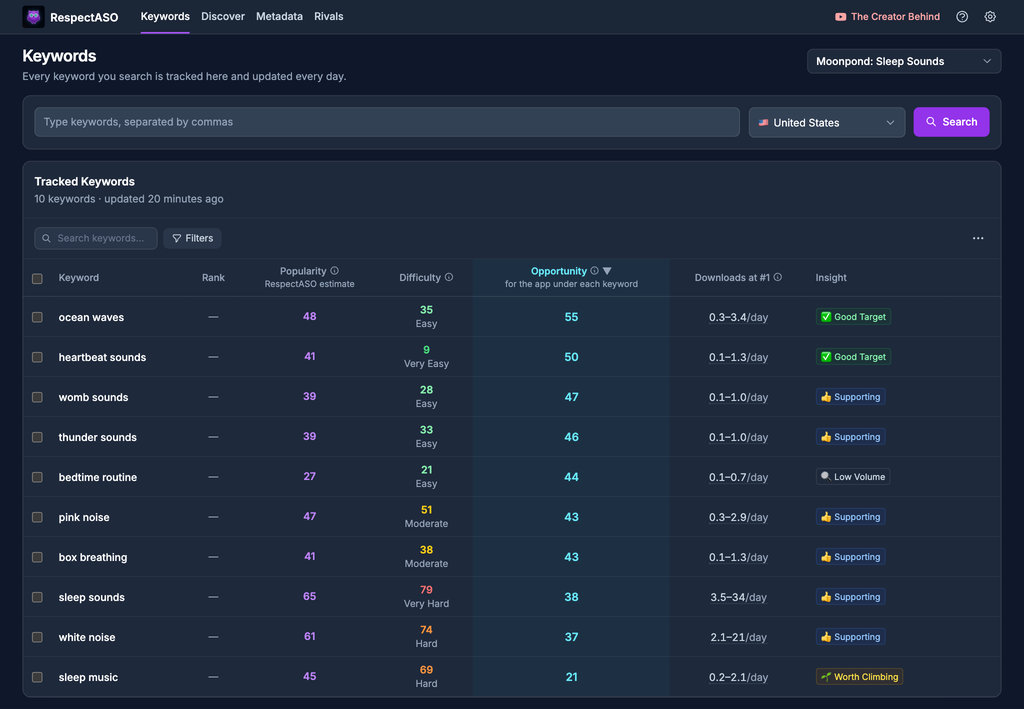
Keyword research in RespectASO: a score and a tag for every keyword
Optimize Your Medical App
Use RespectASO to research keywords and build a data-driven ASO strategy for Medical apps.