United Kingdom App Store
App Store Optimization for United Kingdom: The Complete ASO Guide
ASO guide for the UK App Store. Keyword differences from US English, competition landscape, and localization tips for British users.
The UK App Store
The United Kingdom is the largest English-speaking App Store market outside the United States, and it is easy to treat as a copy of it. It is not: the UK storefront has its own keyword index, its own competition and its own English, and copying US metadata into it leaves British searches unmatched.
British users pay for apps and subscriptions, and search is where most downloads start. They also tend to search with specific phrases, which makes long-tail keywords worth your attention here.
Seasonal Patterns
Christmas and New Year bring the biggest peak, as in the US. The UK adds its own: the August bank holiday, the academic year in September (education apps), and a January health push that runs strong. Changeable weather keeps Weather apps in daily use.
Language and Localization
The UK storefront uses British English (locale code en-GB). Same language as the US store, different words, and the differences decide which searches you match.
Spelling
Apple matches the words in your metadata, so a British spelling and an American one are two different searches:
- "colour" and "color": a UK user searching "colour palette" is looking for the British word.
- "organise" and "organize": the same goes for every -ise and -ize ending.
- "favourite" and "favorite", "catalogue" and "catalog", "centre" and "center", "metre" and "meter".
Put the British spellings in the keyword field of your UK localization. Do not spend title or subtitle characters on spelling variants. The table below measures both spellings of "colour palette" and "organiser" in the UK store, so you can see they are not the same search.
Vocabulary
- "torch" and "flashlight": British users search for a torch.
- "boot sale" and "garage sale": matters for marketplace and selling apps.
- "football" and "soccer": in the UK, football is the sport Americans call soccer, which decides a Sports app's keywords.
- "chemist" and "drugstore", "petrol" and "gas", "motorway" and "highway": matter for health, Travel and navigation apps.
How Hard UK Keywords Are
US apps dominate both stores, but the UK adds its own: British banks, health services and media apps hold their niches, and UK-specific searches only match apps that write for them. Here is how a set of British searches measured, with British and American spellings side by side:
24 app keywords, measured in the UK App Store
Measured by RespectASO on 6 October 2026. Difficulty, from 1 to 100, says how hard the apps already on top are to pass. "In top 10 names" counts the top ten apps with the keyword in their name. How the numbers work.
| Keyword | Difficulty | In top 10 names |
|---|---|---|
| Head terms | ||
| football | 81 Very Hard | 7 of 10 |
| torch | 50 Moderate | 5 of 10 |
| weather | 78 Very Hard | 10 of 10 |
| budget planner | 51 Moderate | 6 of 10 |
| expense organiser | 26 Easy | 0 of 10 |
| money manager | 44 Moderate | 3 of 10 |
| Features and sub-genres | ||
| colour palette | 25 Easy | 3 of 10 |
| color palette | 33 Easy | 2 of 10 |
| colour picker | 33 Easy | 3 of 10 |
| organiser | 47 Moderate | 1 of 10 |
| organizer | 60 Hard | 2 of 10 |
| rain radar | 58 Hard | 4 of 10 |
| Audiences and uses | ||
| boot sale | 15 Very Easy | 0 of 10 |
| chemist | 41 Moderate | 5 of 10 |
| petrol prices | 33 Easy | 2 of 10 |
| football scores | 64 Hard | 4 of 10 |
| train times | 60 Hard | 3 of 10 |
| flashlight | 53 Moderate | 7 of 10 |
| Long-tail phrases | ||
| car boot sale | 11 Very Easy | 0 of 10 |
| money manager and tracker | 30 Easy | 0 of 10 |
| weather radar uk | 56 Hard | 1 of 10 |
| five a side football | 36 Moderate | 5 of 10 |
| petrol price checker | 18 Easy | 0 of 10 |
| daily rain forecast | 33 Easy | 0 of 10 |
Difficulty here runs from 11 for "car boot sale" to 81 for "football". 2 of the 24 keywords score 70 or more, and 5 score under 30. The long-tail phrases have a median difficulty of 31, against 50 for the head terms.
To see popularity, what these keywords would bring your own app, and every other storefront, run them in RespectASO, free on your Mac.
Compare "colour palette" with "color palette", "organiser" with "organizer", and "torch" with "flashlight". The last column shows how many of the top ten apps carry each word in their name, which tells you whether the competition wrote for British users or copied their US metadata. Popularity for each search, and the same keywords in the US store, are in RespectASO.
Keyword Research Strategies for the UK Market
1. Research the UK and the US Together
A keyword's value can differ a lot between the two stores. The Country Opportunity Finder runs one keyword through the storefronts you pick and ranks them by the Opportunity they offer your app, so you see at once whether it is worth more in the UK or the US.
2. Convert Every Keyword to British Spelling
Take your US keyword list and convert each spelling for the UK localization, then use the keyword field's 100 characters for the variants your title and subtitle do not cover.
3. Target UK-Only Searches
Some searches only exist in Britain: institutions (NHS, DVLA, HMRC, council tax), events (Bonfire Night, bank holidays) and local habits ("petrol prices", "train times", "car boot sale"). If your app serves a UK need, these are the first keywords to measure.
Metadata Optimization for the UK Store
The fields are the same as everywhere: title (30 characters), subtitle (30 characters) and keyword field (100 characters).
Title
Keep your brand the same across markets but use the British form of your keyword. "BudgetPal: Expense Organiser" matches British searches and reads right to British users; "BudgetPal: Expense Organizer" does neither.
Subtitle
A British English phrase that does not repeat the title's words. If the title says "organiser", give the subtitle a different keyword, such as "money manager and tracker".
Keyword Field
Fill all 100 characters with British spellings, UK vocabulary and local terms, separated by commas, in singular form, with no articles or prepositions and nothing already in the title or subtitle.
Common Mistakes in the UK Market
- Copying US metadata. American spellings and vocabulary miss British searches.
- No UK localization at all. Without one, you cannot target UK-specific keywords.
- Underrating the UK. British users pay for apps; measure your keywords there before you decide it is too small to bother.
- Assuming the same competitors. Use competitor analysis to see who ranks in the UK; it is not always who ranks in the US.
How RespectASO Helps in the UK Market
RespectASO scores British keywords for your own app: popularity, difficulty, the Opportunity they bring and an Insight tag that says what to do with each. Research the UK and the US side by side, and use the Country Opportunity Finder to compare the UK with every other storefront you pick.
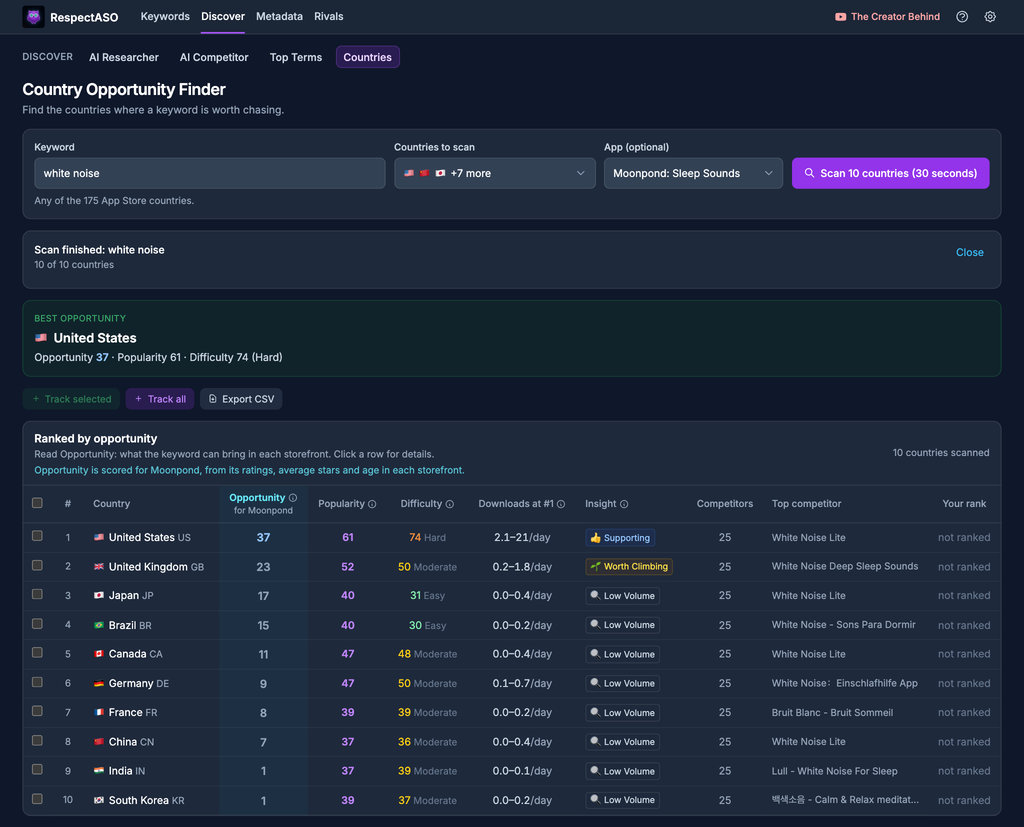
RespectASO's Country Opportunity Finder ranks the storefronts you pick for any keyword
Find the Best Keywords for United Kingdom
See which keywords your app can win in the United Kingdom App Store: RespectASO scores the popularity and difficulty of any keyword there, free on your Mac.