App Store Localization: The Complete Resource Guide
Master App Store localization across 175 storefronts. Country guides, keyword strategies by language, and localization tools to grow your app globally.
The App Store is not one market. It's 30+ individual markets, each with its own language, search behavior, and competitive landscape. Localization is the process of adapting your app's metadata to rank in these markets. For indie developers, it's one of the highest-leverage ASO strategies available: the same app, reaching entirely new audiences, without writing a single line of new code.
Why Localization Matters
Most indie developers optimize for one market (usually the United States) and ignore the rest. This is a missed opportunity. A keyword that's brutally competitive in the US might have almost no competition in Brazil, South Korea, or Germany. Localization lets you capture these opportunities.
The math is straightforward: if your app ranks for 10 keywords in 1 country, and you localize for 10 countries, you potentially rank for 100 keyword-country combinations. Each one is a new channel for organic downloads.
How App Store Localization Works
Apple allows you to set separate metadata (title, subtitle, keyword field) for each storefront. This means you can target different keywords in different markets: not just translate your English metadata, but research what users in each market are actually searching for.
Effective localization requires more than translation. The process involves:
- Market research: Understanding which keywords are popular in each country, since search behavior varies by language and culture.
- Competition analysis: Measuring keyword difficulty per market, since competitive dynamics differ by country.
- Opportunity identification: Using the Country Opportunity Finder to scan all 175 App Store storefronts and find where your keywords have the best opportunity scores.
- Metadata adaptation: Writing market-specific titles, subtitles, and keyword fields optimized for each locale.
The Country Opportunity Finder
RespectASO's Country Opportunity Finder is built specifically for localization strategy. Enter a keyword and it scans all 175 App Store storefronts, showing you the popularity, difficulty, and opportunity score for that keyword in every country, ranked from best to worst opportunity.
This tool answers a question that's almost impossible to research manually: "Where in the world does my app have the best chance of ranking for this keyword?"
Country Guides by Region
Each country has unique characteristics: language complexity, App Store size, competition levels, and user behavior. Our country-specific guides cover keyword strategy, competitive landscape, and localization tips for all 175 App Store storefronts RespectASO supports.
North America
- United States: The largest App Store market. Maximum competition, maximum reward.
- Canada: English and French storefronts. Often used as a soft-launch market.
- Mexico: The largest Spanish-speaking market in the Americas.
Europe
- United Kingdom: Shares language with the US but has different keyword dynamics.
- Germany: Europe's largest economy. German-language keywords unlock a distinct market.
- France: Significant market size with French-language search behavior.
- Spain: Gateway to European Spanish-speaking users.
- Italy: Italian-language market with loyal app users.
- Netherlands: High smartphone penetration, many users search in English.
- Portugal: Portuguese shares keywords with Brazil but has its own competitive dynamics.
- Russia: Cyrillic script requires dedicated keyword research.
- Turkey: Young, mobile-first population with growing App Store activity.
Nordics
- Sweden, Norway, Denmark, Finland: High purchasing power and tech-savvy users. Many search in both local language and English.
Asia-Pacific
- Japan: One of the highest-spending App Store markets. Japanese keyword research is essential.
- South Korea: Highly mobile-first market with Korean-language search dominance.
- China: The largest mobile market by users. Simplified Chinese keywords are critical.
- Taiwan: Traditional Chinese market with distinct search patterns from China.
- Singapore: English-language hub with Southeast Asian reach.
- Thailand: Growing mobile market with Thai-language search.
- Indonesia: Largest Southeast Asian market by population.
- Philippines: English and Filipino bilingual market.
- Vietnam: Rapidly growing App Store market.
India & Middle East
- India: Massive user base with English-language App Store searches.
- Saudi Arabia: Arabic-language market with high spending power.
- UAE: Multilingual market (Arabic and English) with premium users.
South America
- Brazil: Portuguese-language market with enormous growth potential.
- Australia: English-language market with distinct seasonal patterns.
Localization Strategy Tips
Research, Don't Just Translate
Machine-translating your English keywords into German and pasting them into your German storefront is not localization. Users in different countries search differently: they use different terminology, different phrasing, and sometimes completely different concepts to find the same type of app. Always research keyword popularity and difficulty in each target market separately.
Start With High-Opportunity Markets
You do not need to localize for every storefront. Use the Country Opportunity Finder to identify the 3–5 markets where your keywords have the best opportunity scores. Target those first, measure the results, and expand from there.
Consider Language Overlap
Some languages span multiple storefronts. Spanish keywords work across Spain and Mexico (with regional variations). Portuguese connects Brazil and Portugal. English-language metadata carries weight in English-speaking markets like the US, UK, Canada, Australia, Singapore, India, and the Philippines. One language research effort can often apply across multiple markets.
Track Results Per Market
After localizing, monitor your search visibility and rankings in each market separately. A keyword that works in one country may underperform in another despite similar opportunity scores, because local competitive dynamics can shift between your research and your update.
Further Reading
- App Store Localization Strategy for Indie Developers: Detailed guide to building your localization plan
- Keyword Research: The Complete Guide: Master the fundamentals before localizing
- AI ASO tool: localization research with AI, in Pro
- Keyword Research Documentation: How to use the Country Opportunity Finder and other tools
- Glossary: Localization: Definition and key concepts
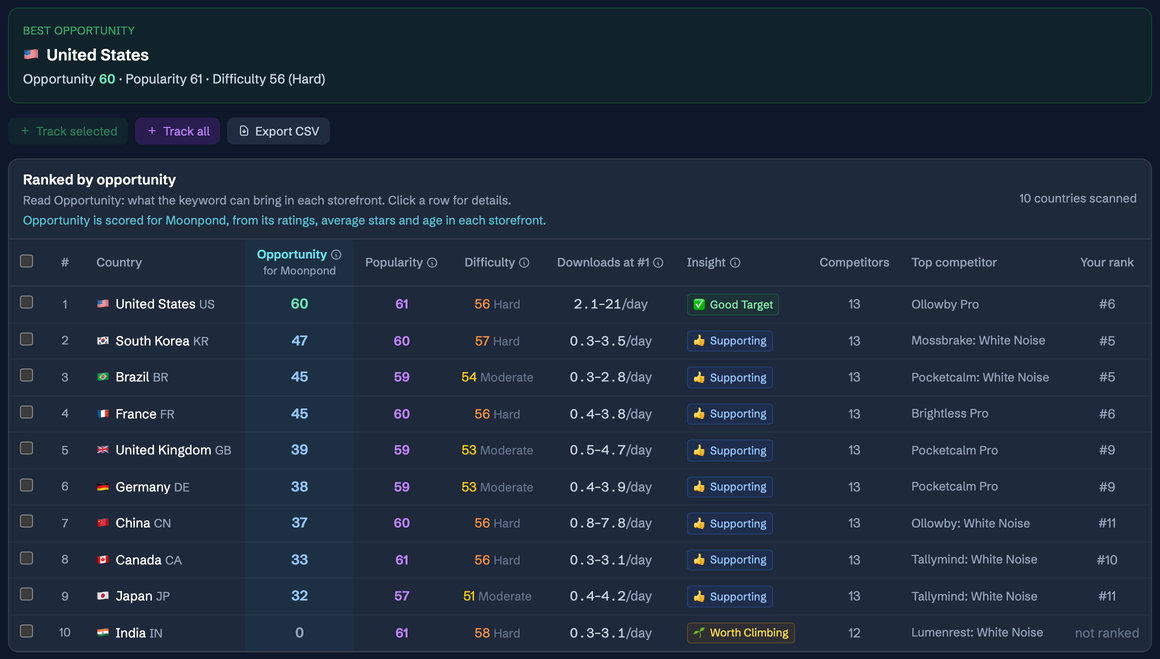
The Country Opportunity Finder scans the storefronts you pick, up to all 175, and ranks them by Opportunity for one keyword
Put this strategy into practice
Download the macOS app and turn the guide into keyword research, market scanning, and competitor checks.