Category Guide
App Store Optimization for Business Apps: Strategy Guide
ASO strategy guide for business apps on iOS. Keyword targeting, B2B positioning, and metadata tips to reach enterprise and professional users.
The Business Category Landscape
Business apps serve professionals, teams, and enterprises — from CRM and project management to invoicing and communication tools. The category sits at the intersection of productivity and commerce, with users who have high intent and low patience. When someone searches for a business app, they're solving a specific professional problem and are willing to pay for the right solution.
This creates a distinct ASO dynamic: keyword popularity is often lower than consumer categories like Games or Entertainment, but conversion rates and user lifetime value are significantly higher. A keyword with popularity 30 in Business can drive more revenue than a popularity-70 keyword in a consumer category.
Keyword Patterns in Business
Problem-Solution Keywords
Business users search for solutions to specific problems rather than browsing for entertainment. Their searches are functional and direct:
- Task-specific: "invoice maker," "expense tracker," "project management"
- Role-specific: "sales CRM," "HR management," "fleet tracking"
- Industry-specific: "restaurant POS," "real estate CRM," "construction management"
The more specific the keyword, the lower the competition. "CRM" has extreme difficulty, but "real estate CRM" or "freelance CRM" can be Sweet Spot keywords with highly qualified users.
B2B vs. B2C Keywords
Distinguish between keywords that attract individual professionals (B2C-style: "invoice app," "business card scanner") and those that attract teams or companies (B2B-style: "team collaboration," "enterprise messaging"). B2C business keywords typically have higher search volume but also higher competition. B2B keywords are lower volume but can deliver disproportionate revenue through enterprise subscriptions.
Metadata Optimization for Business Apps
Trust and Clarity Over Cleverness
Unlike consumer apps where playful branding works, business apps need to communicate competence. Your subtitle should immediately clarify what your app does and who it's for: "Invoice & Estimate Maker" is better than "Simplify Your Business." Users scanning search results need instant recognition that your app solves their problem.
Feature Keywords in the Keyword Field
Business users often search for specific features: "PDF export," "QuickBooks sync," "multi-currency," "receipt scanning." Include these feature-level keywords in your keyword field. Each individual feature keyword may have modest search volume, but collectively they generate qualified traffic from users who know exactly what they need.
Common ASO Mistakes in Business
- Targeting only broad keywords: "Business" and "office" are impossibly competitive. Niche down to your specific function and audience.
- Neglecting trust signals: Business users evaluate ratings heavily. An app below 4.0 stars in Business faces much steeper conversion penalties than in casual categories, because professionals associate low ratings with unreliability.
- Underinvesting in screenshots: Screenshots for business apps should show clean, data-populated interfaces — not empty states. Demonstrate that the app handles real-world complexity.
- Ignoring integrations as keywords: Many business users search for app names they want to integrate with: "Slack integration," "Salesforce connector." If your app integrates with popular business tools, those tool names are high-value keywords.
Competitor Landscape
The Business category is dominated by established SaaS companies (Salesforce, Slack, Microsoft, Notion) whose iOS apps benefit from massive brand recognition and desktop user bases. However, these large apps often optimize poorly for niche keywords — they focus on brand keywords and broad categories. Independent developers can win by targeting specific niches, industries, or workflows that major players don't address.
International Opportunity
Business app search patterns vary by market. Germany and Japan have strong business app markets with language-specific search behavior. Brazil and Mexico have growing professional mobile app usage with less competition. Localized metadata for business-specific terms in these markets can reveal Hidden Gems that English-only optimization misses entirely.
How RespectASO Helps
Use Multi-Keyword Search to compare functional, role-specific, and industry keywords side by side. Business apps benefit from testing keywords across multiple markets — the Country Opportunity Finder can reveal professional markets where your niche keywords face minimal competition, enabling targeted localization for maximum ROI.
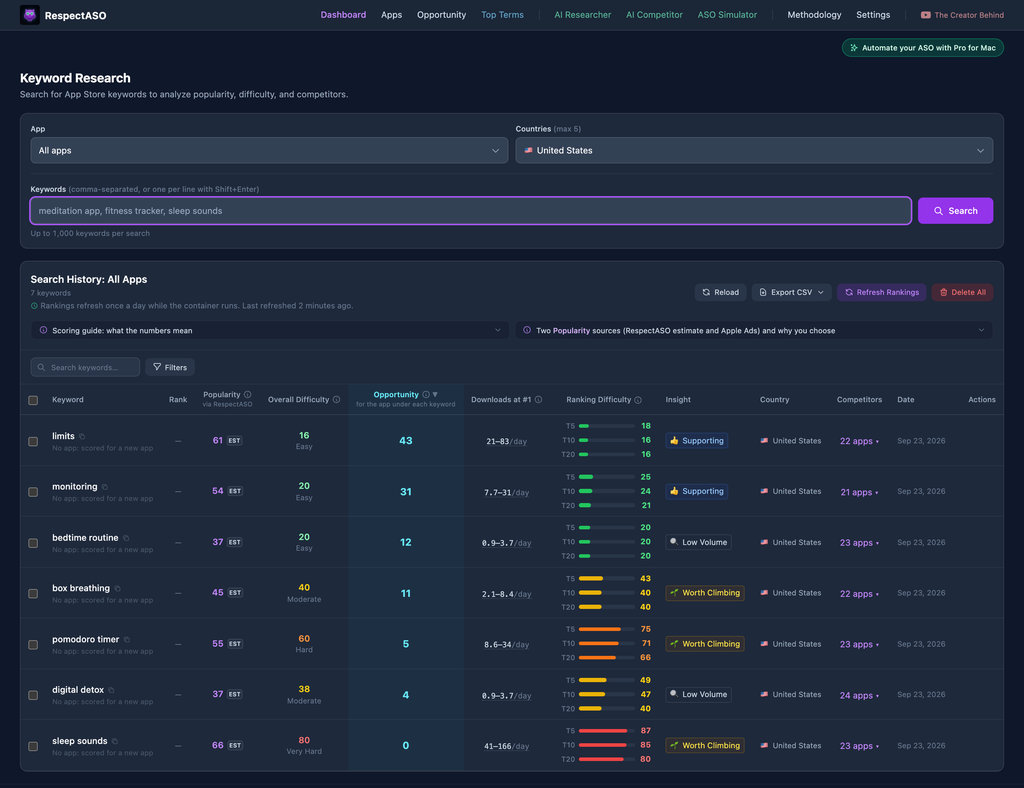
RespectASO's keyword research dashboard: a score and a tag for every keyword
Optimize Your Business App
Use RespectASO to research keywords and build a data-driven ASO strategy for Business apps.