Germany App Store
App Store Optimization for Germany: The Complete ASO Guide
ASO guide for the German App Store, Europe's largest market. German keyword research, compound word strategies, and metadata optimization tips.
The German App Store
Germany is Europe's largest App Store market, and German users pay for software they trust. Many developers still skip it because they cannot write German metadata, which leaves the field to the apps that do. A well-written German listing stands out, both to search and to the people reading it.
German users care about quality and about what an app does with their data. An app that keeps data on the device, and says so plainly in its listing, starts with an advantage here.
Seasonal Patterns
Christmas brings the biggest download peak. September and October lift event, travel and food apps around Oktoberfest. School starts between late July and mid-September depending on the state, so education demand rises over August. The January health and fitness surge is strong here too.
Language and Localization
The German storefront uses German (locale code de-DE). The same language serves Austria and German-speaking Switzerland, which have storefronts of their own.
Compound Words
German builds long nouns from short ones, and people search both ways:
- Haushaltsbuch: "household budget book" (a budget app)
- Schlafüberwachung: "sleep monitoring"
- Kalorienzähler: "calorie counter"
A search for "Kalorienzähler" is not the same search as "Kalorien" or "Zähler" on their own, so plan your keyword field for both the compound and its parts. The table below measures "kalorienzähler" next to "kalorien" and "zähler", and "schlafüberwachung" next to "schlaf" and "tracker", so you can see how differently they compete.
Word Length
German words are long, and Apple's limits are the same as in English: 30 characters for the title, 30 for the subtitle and 100 for the keyword field. "Aufgabenverwaltung" (task management) alone takes 18 of your 30 subtitle characters, so choose words for their length as well as their meaning.
Umlauts and ß
- Many people type without umlauts on a phone keyboard, so "Kalorienzaehler" and "Schlafueberwachung" are searches too. The table measures both spellings of each.
- Put the spelling variants in the keyword field ("Gemüse" and "Gemuese", "Straße" and "Strasse"), never in the title or subtitle.
How Hard German Keywords Are
German banks, delivery services and broadcasters hold their own niches with large budgets. Elsewhere, many global apps run on thin or machine-translated German metadata, so a natural German listing stands out. Here is how a set of German searches measured, compound words, their parts, umlaut spellings and English loanwords included:
24 app keywords, measured in the German App Store
Measured by RespectASO on 6 October 2026. Difficulty, from 1 to 100, says how hard the apps already on top are to pass. "In top 10 names" counts the top ten apps with the keyword in their name. How the numbers work.
| Keyword | Difficulty | In top 10 names |
|---|---|---|
| Head terms | ||
| kalorienzähler | 66 Hard | 6 of 10 |
| haushaltsbuch | 60 Hard | 8 of 10 |
| schlaftracker | 57 Hard | 7 of 10 |
| aufgabenverwaltung | 8 Very Easy | 3 of 10 |
| fitness app | 63 Hard | 4 of 10 |
| planner | 47 Moderate | 1 of 10 |
| Features and sub-genres | ||
| kalorien | 70 Hard | 9 of 10 |
| zähler | 53 Moderate | 8 of 10 |
| schlaf | 69 Hard | 9 of 10 |
| tracker | 76 Very Hard | 7 of 10 |
| schlafüberwachung | 41 Moderate | 0 of 10 |
| budget app | 39 Moderate | 0 of 10 |
| Audiences and uses | ||
| kalorienzaehler | 41 Moderate | 1 of 10 |
| schlafueberwachung | No apps found for this keyword | |
| haushaltsbuch app | 41 Moderate | 0 of 10 |
| trainingsplan | 58 Hard | 2 of 10 |
| abnehmen | 65 Hard | 6 of 10 |
| rezepte | 71 Hard | 9 of 10 |
| Long-tail phrases | ||
| sport fitness kalorien | 33 Easy | 0 of 10 |
| training und ernährung | 23 Easy | 1 of 10 |
| kalorienzähler app kostenlos | 47 Moderate | 0 of 10 |
| haushaltsbuch ohne bank | 4 Very Easy | 0 of 10 |
| trainingsplan für zuhause | 38 Moderate | 0 of 10 |
| einkaufsliste mit partner | 4 Very Easy | 0 of 10 |
Difficulty here runs from 4 for "haushaltsbuch ohne bank" to 76 for "tracker". 3 of the 23 keywords score 70 or more, and 4 score under 30. The long-tail phrases have a median difficulty of 28, against 58 for the head terms.
To see popularity, what these keywords would bring your own app, and every other storefront, run them in RespectASO, free on your Mac.
Compare each compound with its parts and each umlaut spelling with its plain form. Check the English loanwords too ("planner", "tracker", "fitness app"): German users type them, and the last column shows how many of the top apps carry each one in their name. Popularity for each word, and the same keywords in Austria and Switzerland, are in RespectASO.
Keyword Research Strategies for Germany
1. Measure Compounds and Their Parts
For every keyword, measure the compound and its parts together: "Schlaftracker" and "Schlaf" with "Tracker" can score very differently on popularity and difficulty. RespectASO scores a whole list at once.
2. Add English Loanwords
German users search with English tech words: "Tracker", "App", "Planner", "Fitness". Add the ones that fit your app to the German keyword field next to the German terms.
3. Compare Germany with Other Markets
The Country Opportunity Finder runs one keyword through the storefronts you pick and ranks them by the Opportunity they offer your app, so you see what Germany is worth next to the US or the UK for your keywords.
4. Check Austrian and Swiss Words
Vocabulary differs: "Paradeiser" in Austria for "Tomate", "Velo" in Switzerland for "Fahrrad". If you target all three storefronts, give each one its own keyword field.
Metadata Optimization for the German Store
Title (30 Characters)
Your brand plus one short German keyword. Shorten a long brand for the German localization if you must. "FitLog: Kalorienzähler" (22 characters) fits; "FitLog: Gewichts- und Kalorientracker" (37 characters) does not.
Subtitle (30 Characters)
Your second keyword phrase, in German that reads naturally. "Training & Ernährung" (20 characters) reads well; "Sport Fitness Kalorien" (22 characters) reads like a list of keywords.
Keyword Field (100 Characters)
Fill every character: compound words, their parts, English loanwords, umlaut spellings and Austrian or Swiss terms. Use commas, singular forms, and no articles or prepositions.
Common Mistakes in the German Market
- Machine-translated metadata. German users recognize it at once, and it costs you taps. Write in German or have a native speaker review.
- Ignoring compound words. The compound is often the most natural way to search for your category.
- Translating an English plan. German words often do not fit where the English ones did. Research in German and build the German metadata from that.
- Hiding your privacy story. If your app keeps data on the device, say so in the listing.
- Leaving Germany for later. For most apps it is the first European localization worth doing.
How RespectASO Helps in the German Market
RespectASO scores German keywords the same way as English ones: popularity, difficulty and the Opportunity they bring your app, with an Insight tag that says what to do with each. A whole list of compounds, parts and loanwords takes one search, and the Country Opportunity Finder compares Germany with France, the Netherlands and the other storefronts you pick.
It runs on your Mac and keeps your keyword research there, which suits the market it is researching.
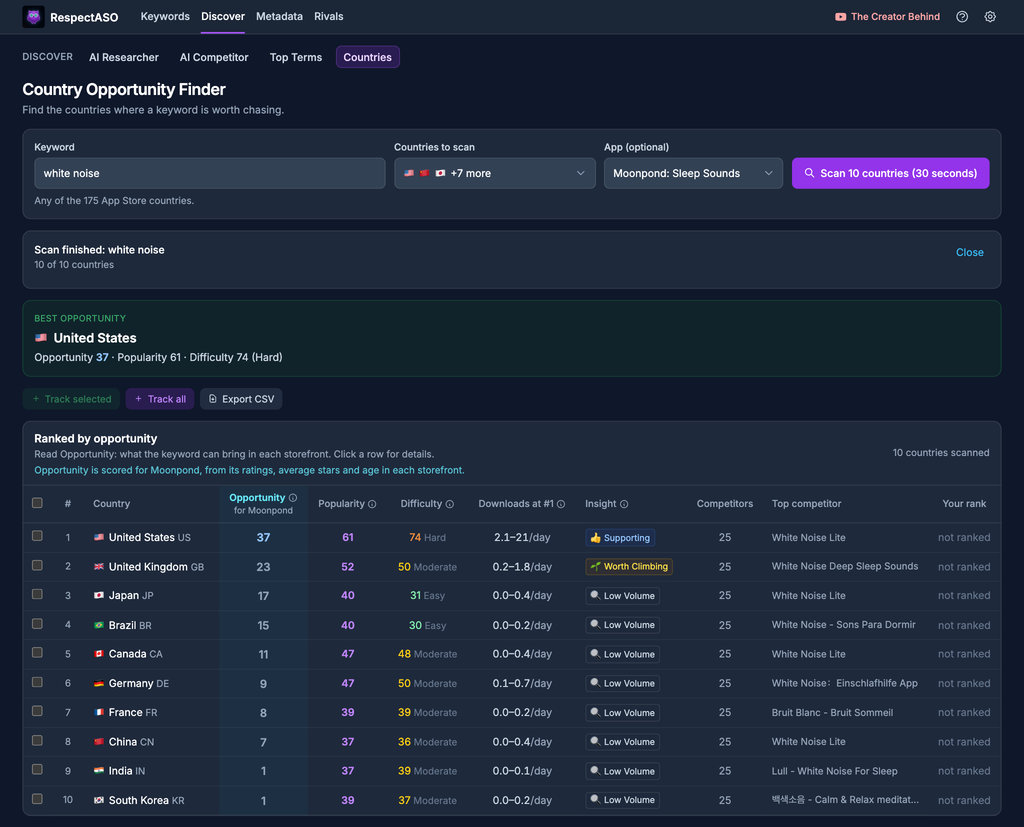
RespectASO's Country Opportunity Finder ranks the storefronts you pick for any keyword
Find the Best Keywords for Germany
See which keywords your app can win in the Germany App Store: RespectASO scores the popularity and difficulty of any keyword there, free on your Mac.