Japan App Store
App Store Optimization for Japan: The Complete ASO Guide
ASO guide for the Japanese App Store, the world's #2 market by revenue. Japanese keyword research with kanji, hiragana, and katakana strategies.
The Japanese App Store
Japanese users pay for apps they trust, subscribe across categories from Productivity to Health & Fitness and Education, and expect a listing written in natural Japanese. Most international developers never write Japanese metadata, so the apps you compete with for a Japanese keyword are the ones that did.
Search is still the main way apps are found, alongside App Store editorial features and word of mouth on LINE and X. Keyword work in Japanese is harder than in English, which is exactly why it pays.
Seasonal Patterns
Japan's calendar differs from Western markets:
- New Year (Oshōgatsu): a holiday week and the biggest download period, with resolution behavior starting in late December.
- Golden Week (late April to early May): national holidays that lift travel, entertainment and leisure apps.
- School year start (April): Japanese schools start in April, not September, so education demand peaks in March and April.
- Summer festivals (July and August): matsuri season brings event searches.
- Bonus seasons (June and December): many workers receive twice-yearly bonuses, and spending on premium apps follows.
Language and Localization
Japanese (locale code ja-JP) is the hardest language for keyword research among the 175 storefronts RespectASO covers, because one idea can be written in three scripts and people search in all of them.
Three Writing Systems
- Kanji (漢字): Chinese characters used for most content words. "家計簿" (household account book, the word for a budget app) is three kanji.
- Hiragana (ひらがな): phonetic script for grammar and native words, and what people type when they do not remember the kanji: "かけいぼ" instead of "家計簿".
- Katakana (カタカナ): phonetic script for loanwords: "アプリ" (app), "フィットネス" (fitness), "カレンダー" (calendar).
"Calendar" can be searched as "カレンダー" (katakana), "暦" (the kanji for a traditional calendar) or "かれんだー" (hiragana). Each form is its own search with its own competition, and the table below measures these sets side by side so you can see how differently the same idea competes in each script.
Romaji and English Keywords
Some searches are typed in Latin script, especially for tech terms: "timer" is searched in English as well as "タイマー". Both forms are in the table below. A few English and romaji words in your keyword field cover these searches.
Character Efficiency
Japanese is dense: "家計簿アプリ" (household budget app) is 6 characters, against 24 for "Household Budget Tracker". Apple's 30-character title and subtitle hold far more meaning in Japanese, so use the room for a second keyword rather than filler.
How Hard Japanese Keywords Are
Large Japanese publishers spend most of their effort on games, and fewer international apps carry Japanese metadata for everyday tools. Compare "ゲーム" and "パズル" with the budget, fitness and study searches in this set of common Japanese searches, measured across all three scripts and a few English words:
24 app keywords, measured in the Japanese App Store
Measured by RespectASO on 6 October 2026. Difficulty, from 1 to 100, says how hard the apps already on top are to pass. "In top 10 names" counts the top ten apps with the keyword in their name. How the numbers work.
| Keyword | Difficulty | In top 10 names |
|---|---|---|
| Head terms | ||
| 家計簿 | 78 Very Hard | 10 of 10 |
| カレンダー | 81 Very Hard | 10 of 10 |
| タイマー | 63 Hard | 7 of 10 |
| ダイエット | 71 Hard | 10 of 10 |
| ゲーム | 78 Very Hard | 8 of 10 |
| メモ | 76 Very Hard | 8 of 10 |
| Features and sub-genres | ||
| 家計簿アプリ | 51 Moderate | 2 of 10 |
| かけいぼ | 70 Hard | 6 of 10 |
| 暦 | 40 Moderate | 9 of 10 |
| かれんだー | 54 Moderate | 1 of 10 |
| timer | 46 Moderate | 3 of 10 |
| パズル | 80 Very Hard | 7 of 10 |
| Audiences and uses | ||
| トレーニング | 67 Hard | 2 of 10 |
| レシピ | 68 Hard | 8 of 10 |
| 筋トレ | 65 Hard | 9 of 10 |
| 勉強 | 72 Hard | 5 of 10 |
| フィットネス | 52 Moderate | 3 of 10 |
| タスク管理 | 62 Hard | 3 of 10 |
| Long-tail phrases | ||
| 家計簿 アプリ 無料 | 51 Moderate | 0 of 10 |
| ダイエット 記録 アプリ | 50 Moderate | 0 of 10 |
| 英語 勉強 アプリ | 53 Moderate | 0 of 10 |
| 筋トレ 自宅 初心者 | 16 Easy | 0 of 10 |
| 睡眠 記録 アプリ | 45 Moderate | 0 of 10 |
| レシピ 簡単 夕飯 | 9 Very Easy | 0 of 10 |
Difficulty here runs from 9 for "レシピ 簡単 夕飯" to 81 for "カレンダー". 8 of the 24 keywords score 70 or more, and 2 score under 30. The long-tail phrases have a median difficulty of 47, against 77 for the head terms.
To see popularity, what these keywords would bring your own app, and every other storefront, run them in RespectASO, free on your Mac.
Compare the script variants of the same idea: "家計簿" with "かけいぼ", and "カレンダー" with "暦" and "かれんだー". The last column shows how many of the top ten apps carry each form in their name, which tells you which forms the competition has written for and which they left open. Popularity for each form, and every other storefront, is in RespectASO.
Keyword Research Strategies for Japan
1. Research Every Script Form
For each keyword, measure the kanji, katakana and hiragana forms together and keep the forms with the best mix of popularity and difficulty for your app. RespectASO scores a whole list at once, so a set of variants takes one search.
2. Include Katakana Loanwords
"ダイエット" (diet), "トレーニング" (training), "レシピ" (recipe) and "タイマー" (timer) are everyday Japanese searches that English-speaking developers rarely think to add. Put the ones that fit your app in your keyword field.
3. Update Ahead of the Seasons
Change your Japanese metadata before each peak: Golden Week keywords by late March, cherry blossom (桜, さくら) keywords for March and April, New Year keywords in November.
4. Compare Japan with Other Markets
The Country Opportunity Finder runs one keyword through the storefronts you pick and ranks them by the Opportunity they offer your app, which tells you whether a Japanese localization is worth the work for your keywords before you commission it.
Metadata Optimization for the Japanese Store
Title (30 Characters)
Your brand (in katakana if it has a Japanese reading) plus your main keyword in its most natural script. Do not mix scripts without a reason; it reads as careless to Japanese users.
Subtitle (30 Characters)
A short benefit phrase in natural Japanese. Stacked keywords are noticed at once and cost you taps, so have a native speaker review it.
Keyword Field (100 Characters)
Fill it with the other script forms, English and romaji words, synonyms, short forms and seasonal terms, separated by commas. Japanese characters are compact, so 100 characters hold many keywords.
Common Mistakes in the Japanese Market
- Using one script only. Katakana alone misses people who type kanji, and kanji alone misses people who type katakana. Cover the forms people use.
- Machine-translated metadata. Japanese users notice unnatural phrasing immediately. Use a human translator or a native review.
- A sparse listing. Japanese users expect detailed, polished screenshots and descriptions; a minimal Western listing can look unfinished.
- Western seasonal timing. The school year starts in April, Golden Week is in May, and bonuses arrive in June and December.
- Skipping Japan because it is hard. Even a basic Japanese localization puts you ahead of the many international apps that never write one.
How RespectASO Helps in the Japanese Market
RespectASO scores Japanese keywords the same way as English ones, in every script: popularity, difficulty and the Opportunity they bring your app, with an Insight tag that says what to do with each. A whole list of variants takes one search, and the Country Opportunity Finder compares Japan with South Korea, China and the other storefronts you pick.
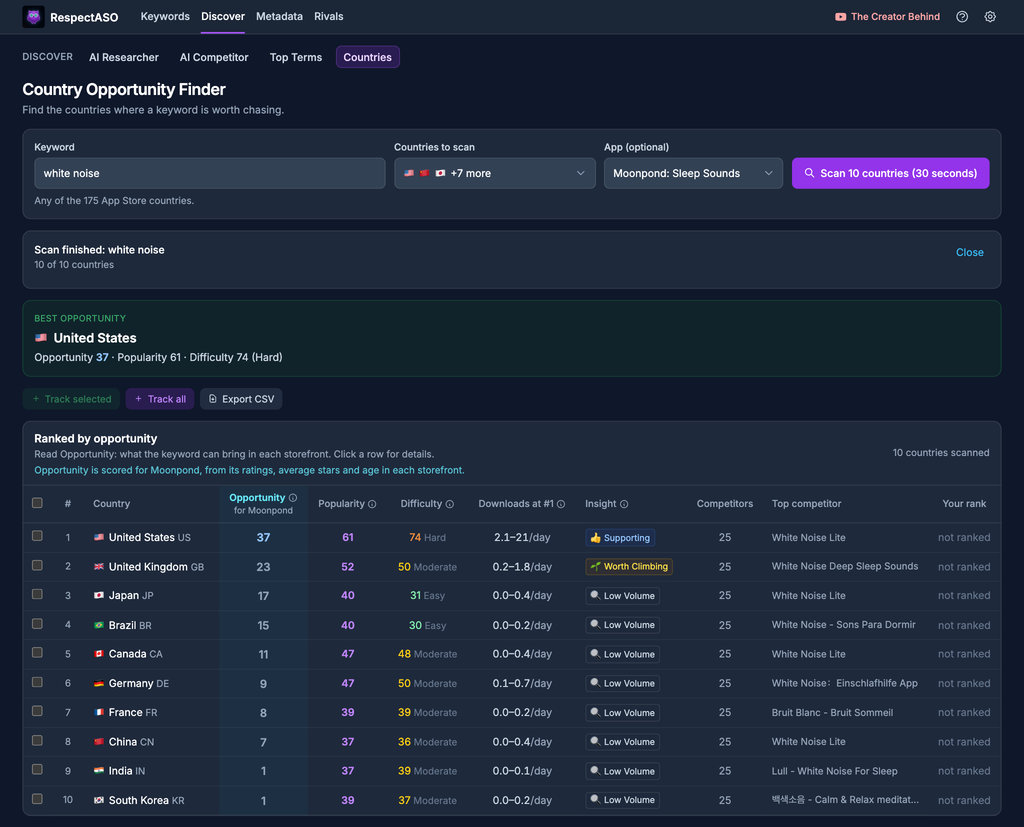
RespectASO's Country Opportunity Finder ranks the storefronts you pick for any keyword
Find the Best Keywords for Japan
See which keywords your app can win in the Japan App Store: RespectASO scores the popularity and difficulty of any keyword there, free on your Mac.