Canada App Store
App Store Optimization for Canada: The Complete ASO Guide
ASO guide for the Canadian App Store. Bilingual keyword strategy for English and French, competition analysis, and metadata optimization for Canadian users.
The Canadian App Store: A Bilingual Market with Unique Opportunities
Canada is one of the most underestimated App Store markets in the world. Sitting right next to the United States, it gets overshadowed by its southern neighbor. But Canada offers something no other English-speaking market can match: a mandatory bilingual market with separate English and French keyword indices. Developers who understand this dual-language dynamic can capture traffic that monolingual competitors miss entirely.
Canada ranks consistently in the top ten globally for App Store consumer spending. Canadian iPhone users are affluent, tech-forward, and willing to pay for quality apps. Yet competition is notably thinner than in the US, making Canada one of the best risk-reward markets for indie developers expanding beyond their home country.
User Behavior and Revenue Potential
Canadian smartphone users closely mirror US behavior in many ways: high app usage, comfort with subscriptions, and search-driven discovery. However, there are distinct differences worth noting. Canadians tend to favor locally relevant apps, particularly for banking, weather, transit, and government services. Apps that surface their Canadian availability or relevance in metadata perform disproportionately well.
The revenue potential is significant. Canada's per-user spending is among the highest globally, and the iPhone market share in Canada is strong, particularly in urban centers like Toronto, Vancouver, and Montreal. For indie developers, this means a smaller total addressable market than the US, but one where each user is highly valuable.
Seasonal Trends
Canadian seasonal patterns overlap with the US but have local flavors. The holiday download spike runs from late November through January. Back-to-school season in September drives education app downloads. Canadian winters are long and harsh, creating sustained demand for indoor entertainment, fitness-at-home, and meal planning apps from November through March. Tax season hits in spring (filing deadline is April 30), driving finance and tax-prep app downloads.
Language and Localization: The Bilingual Advantage
This is where Canada gets interesting. Apple's Canadian storefront supports two official locales: English (Canada) (en-CA) and French (Canada) (fr-CA). Each locale has its own keyword index, which means you effectively get two separate sets of metadata for the same storefront.
English (Canada)
Canadian English is closer to American English than British English in most respects, but there are important differences:
- Spelling hybrids: Canadians use a mix of British and American spellings. "Colour" and "favourite" (British) are standard, but "organize" and "realize" (American -ize endings) are preferred over the British -ise forms.
- Vocabulary: Canadians say "toque" (not "beanie"), "washroom" (not "restroom" or "bathroom"), "hydro" (for electricity in Ontario), and "loonie/toonie" (nicknames for two Canadian coins). These matter for apps in relevant categories.
- Cross-indexing with US: Apple may partially cross-index
en-CAanden-USkeywords due to language similarity. However, creating a dedicated Canadian English localization lets you add Canada-specific terms without disturbing your US keyword strategy.
French (Canada)
Here is the real opportunity. Over 7 million Canadians speak French as their primary language, concentrated in Quebec but also significant in New Brunswick and Ontario. The fr-CA locale is a separate keyword index, and most non-Canadian developers completely ignore it.
Canadian French (québécois) differs from France's French (fr-FR):
- "courriel" vs "email": Quebec French uses "courriel" for email, while France uses "email" or "e-mail"
- "magasiner" vs "faire du shopping": different verbs for shopping
- "char" vs "voiture": informal Quebec French for car
- Technical vocabulary: Quebec's Office québécois de la langue française actively creates French equivalents for English tech terms, and these are what Quebec users actually search for
By creating a fr-CA localization, you gain access to an entirely separate keyword index with dramatically lower competition. Most US-based competitors have no French metadata at all, giving you an uncontested field.
Competition Landscape
The Canadian App Store has a fascinating competitive dynamic. US publishers dominate the English-language rankings (their US optimization often carries over), but the French-language rankings are far less crowded. Keyword difficulty in English Canada typically falls between US and UK levels: lower than the US, slightly higher than the UK for most terms.
In French Canada, difficulty drops substantially. Many global apps simply do not have French Canadian metadata, which means even moderate-effort localization can put you on page one for valuable francophone search terms.
Local Competitors to Watch
Canadian-made apps often perform strongly in their home market due to local relevance: Canadian banking apps (RBC, TD, Scotiabank), CBC/Radio-Canada media apps, Canadian weather services, and government services apps. In categories where these local players dominate, competing for generic terms is hard, but niche keywords around specific use cases remain open.
Keyword Research Strategies for the Canadian Market
1. Research Both Locales Separately
Use RespectASO to research keywords in Canada alongside the US and France. Compare popularity and difficulty across all three to find where your keywords have the best opportunity. A keyword that is Worth Climbing in the US may be a Sweet Spot in Canada.
2. Build a Dedicated French Keyword List
Do not simply translate your English keywords into French. Research what French Canadian users actually search for. The phrasing, word order, and preferred vocabulary differ from direct translations. RespectASO's keyword research works in any supported market, letting you evaluate French keyword candidates with the same scoring rigor as English ones.
3. Exploit the Bilingual Gap
Many app categories have a massive gap between English and French optimization in Canada. If you can fill that gap, you gain visibility to millions of francophone users with minimal competition. This is one of the highest-ROI localization efforts available in any market.
4. Use Canada as a US Testing Ground
Because Canadian English is close to American English but the market is less competitive, many experienced ASO practitioners use Canada as a testing ground for keyword experiments before rolling changes to the US. If a keyword performs well in Canada, it is a strong signal that it will perform at least adequately in the US.
Metadata Optimization for the Canadian Store
English Metadata
Your Canadian English title and subtitle can be identical or very similar to your US versions, unless you have Canada-specific keywords worth targeting. Use the keyword field (100 characters) for Canadian English spellings ("colour," "favourite," "centre") and Canada-specific vocabulary.
French Metadata
Create a fully separate French Canadian localization. Translate your title and subtitle into natural Canadian French, not France French. Use the keyword field for québécois terminology and French equivalents of your English keywords. This is an entirely separate 100-character keyword space that most competitors are not using.
Common Mistakes in the Canadian Market
- Ignoring the French localization entirely. This is the biggest missed opportunity. You are leaving an entire keyword index (and millions of potential users) on the table.
- Using France French instead of Canadian French. Quebec users notice the difference. Using
fr-FRvocabulary for afr-CAlocalization is better than nothing, but less effective than proper québécois phrasing. - Assuming US optimization is sufficient. While there is keyword cross-indexing between
en-USanden-CA, it is unreliable. Always create a dedicated Canadian localization. - Overlooking Canadian cultural context. Referencing US-specific things (Thanksgiving in November, US tax deadlines, US health insurance) in your app or metadata while targeting Canada creates friction with Canadian users.
How RespectASO Helps in the Canadian Market
RespectASO's Country Opportunity Finder is particularly powerful for Canada because it lets you compare opportunity scores across all 175 App Store storefronts for any keyword. You can instantly see whether a keyword is more viable in Canada than the US, and by how much.
The multi-country search feature (up to 5 countries simultaneously) lets you research Canada, the US, and France side by side, giving you a complete picture of English and French keyword dynamics across the markets that matter most. With scoring data for popularity, difficulty, and opportunity, you can make informed decisions about where to invest your metadata optimization effort.
For the bilingual strategy specifically, RespectASO enables you to research French keywords with the same quantitative rigor as English ones. No guessing, no relying on Google Translate: real popularity and difficulty data for every keyword candidate in every market.
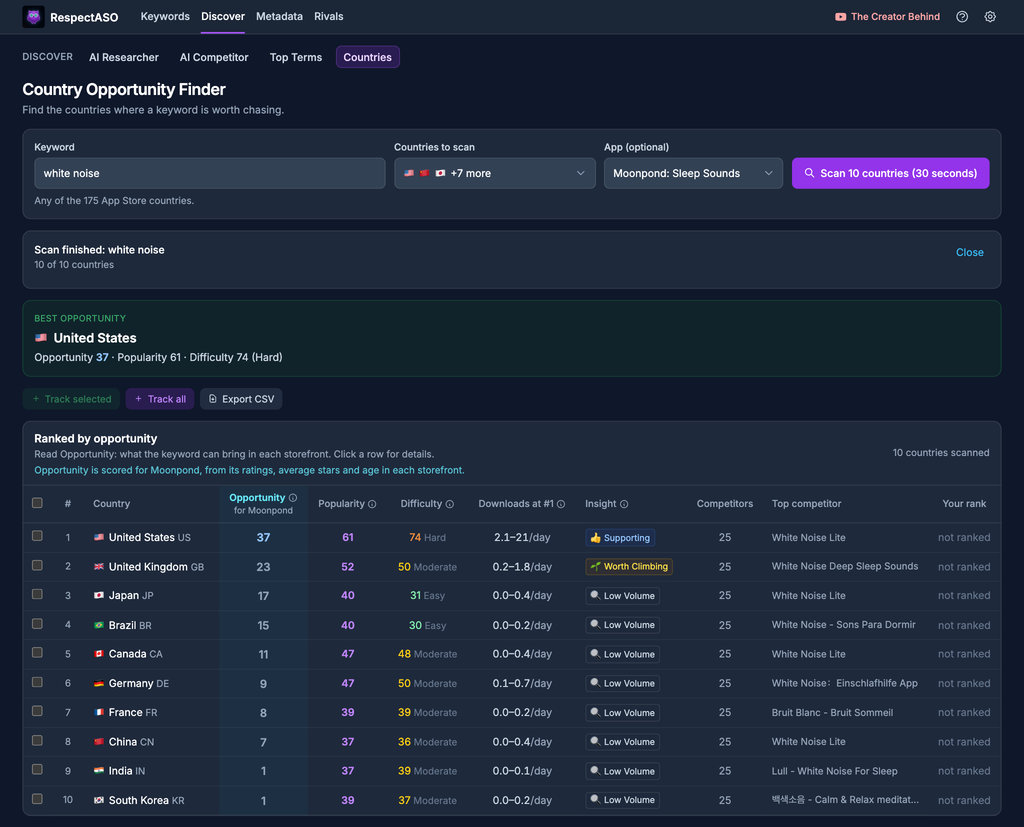
RespectASO's Country Opportunity Finder ranks the storefronts you pick for any keyword
Find the Best Keywords for Canada
See which keywords your app can win in the Canada App Store: RespectASO scores the popularity and difficulty of any keyword there, free on your Mac.