Australia App Store
App Store Optimization for Australia: The Complete ASO Guide
ASO guide for the Australian App Store. Keyword research strategies, seasonal trends, and competition insights for the Australian market.
The Australian App Store: A High-Value Market with Southern Hemisphere Timing
Australia punches well above its weight in the App Store. With a population of just 26 million, it consistently ranks in the top ten worldwide for per-user revenue, driven by high iPhone market share, strong purchasing power, and a tech-savvy consumer base. For indie developers, Australia offers a compelling combination: affluent users who pay for quality apps, noticeably less competition than the United States, and a seasonal calendar that is flipped from the Northern Hemisphere, which creates unique optimization opportunities.
The Australian App Store (en-AU) is one of three major English-speaking storefronts alongside the US and UK. Many developers treat it as an afterthought, which is precisely what makes it an opportunity: lower competition for the same language means better opportunity scores for keywords that are fiercely contested elsewhere.
User Behavior and Revenue Potential
Australians are among the world's most enthusiastic smartphone users. iPhone holds a strong market share in Australia (stronger than in most European countries), and Australian users are notably willing to pay for apps and subscriptions. The average revenue per user in Australia is comparable to Western European markets and significantly higher than most Asian markets.
App discovery follows the standard pattern: search is the dominant channel. Australian users tend to use practical, no-nonsense search terms. They search for what an app does ("budget tracker," "meal planner," "surf report") rather than category browsing. This means keyword optimization is the single most effective growth lever in this market.
The Southern Hemisphere Advantage
Australia's seasons are inverted relative to the Northern Hemisphere, and this creates a genuine strategic advantage for developers who pay attention:
- Summer is December–February. While Northern Hemisphere markets are in winter, Australians are searching for beach, outdoor, and summer fitness apps. You can target summer-related keywords in December with minimal competition from Northern Hemisphere developers who are focused on holiday/winter content.
- Back-to-school is late January/early February. Australian schools start in late January or early February, months ahead of Northern Hemisphere markets. Education app developers can ride Australia's back-to-school wave as a leading indicator for what will work globally.
- Tax season is July–October. The Australian financial year ends June 30, so tax-related app searches spike in July, not April like the US. Finance apps can target Australian tax keywords with almost no international competition.
- New Year's fitness resolutions coincide with summer weather, creating an even stronger January surge for Health & Fitness apps than in Northern markets.
Language and Localization
Australian English (en-AU) blends British and American influences with its own distinctive vocabulary. For keyword research purposes, here is what matters:
Spelling
Australia follows British English spelling conventions: "colour," "favourite," "organise," "centre." If your US metadata uses American spellings, create a separate Australian localization with British/Australian spellings in the keyword field.
Australian Vocabulary
Australians have unique terms that affect search behavior:
- "ute" vs "truck/pickup": automotive apps take note
- "servo" vs "gas station/petrol station": for fuel and driving apps
- "brekkie" vs "breakfast": informal but commonly searched in Food & Drink contexts
- "AFL" and "cricket": the dominant sports in Australia. "Football" in Australia usually means Australian Rules Football (AFL), not soccer or American football
- "chemist" vs "pharmacy": Australians use both, but "chemist" is more common in casual speech
Abbreviations and Local Services
Australian users frequently search using local abbreviations: "TGA" (Therapeutic Goods Administration), "ATO" (Australian Taxation Office), "NBN" (National Broadband Network), "Medicare" (Australia's public health system, different from US Medicare). If your app interacts with any Australian institution, include these abbreviations in your keyword field.
Competition Landscape
Australia's App Store competition level sits clearly below the US and slightly below the UK. For identical keywords, difficulty scores are typically 15–25 points lower than in the US. This means many keywords that are categorized as "Worth Climbing" in the US fall into the "Good Target" or Sweet Spot range in Australia.
The competitive landscape is divided between global apps (which rank everywhere due to massive download volumes), US apps with passive Australian rankings (due to language similarity), and local Australian apps. The local players are strongest in banking, media, government services, and sports: categories deeply tied to national infrastructure.
Keyword Research Strategies for Australia
1. Compare Australia Against US and UK Simultaneously
RespectASO lets you search keywords across up to 5 countries at once. Always include Australia alongside the US and UK to compare popularity and difficulty. You will frequently find that keywords with poor opportunity in the US have excellent profiles in Australia.
2. Exploit Seasonal Inversions
Build a seasonal keyword calendar for Australia that is six months offset from your Northern Hemisphere strategy. "Summer workout," "beach body," and "sunscreen reminder" are high-value keywords in December and January in Australia, months when no Northern Hemisphere developer is thinking about summer.
3. Target Australia-Specific Long-Tail Keywords
"Best budget app Australia" or "meal plan AUD" are long-tail keywords with high intent and minimal competition. Australian users often include "Australia" or "AU" in searches when looking for locally relevant apps, creating long-tail opportunities that global competitors miss.
4. Use the Country Opportunity Finder
RespectASO's Country Opportunity Finder is ideal for the Australia use case. Enter any keyword and see its opportunity score across all 175 App Store storefronts. Australia frequently surfaces as one of the top-opportunity markets for keywords that are overcrowded in the US, making it a reliable expansion target.
Metadata Optimization for the Australian Store
Title (30 Characters)
If your app has any Australian relevance, consider mentioning it in the title for the en-AU localization. "BudgetTrack: Expense Planner" works globally, but for a finance app you might test "BudgetTrack: AUD Tracker" in Australia if "AUD" has keyword value.
Subtitle (30 Characters)
Use your second-priority keyword phrase with Australian English spelling. Do not repeat words from your title. Focus on a benefit-oriented phrase in natural English.
Keyword Field (100 Characters)
Dedicate this to Australian-specific terms: British/Australian spellings, local vocabulary, abbreviations for Australian institutions, and seasonal terms. Do not repeat words from your title or subtitle. Separate with commas, use singular forms, and skip prepositions.
Common Mistakes in the Australian Market
- Ignoring seasonal differences. Marketing winter fitness routines to Australians in July (their winter) works, but promoting "summer beach body" in June does not. Align your metadata updates to the Southern Hemisphere calendar.
- Reusing US metadata without changes. American spellings miss Australian search terms. Create a dedicated
en-AUlocalization even if the differences seem minor. - Underestimating the market. Australia's small population masks its high per-user value. A well-optimized Australian localization can generate meaningful revenue with relatively modest download numbers.
- Not including local currency references. Australian users sometimes search with "AUD" or "AU" to find locally relevant financial, shopping, or pricing apps. If currency is relevant to your app, include these in your keyword field.
- Treating it the same as the UK. While both use British-derived spellings, Australian vocabulary, sports, and cultural references are distinct. The UK and Australia should have separate keyword strategies.
How RespectASO Helps in the Australian Market
RespectASO gives you everything needed to build a data-driven Australian keyword strategy. The scoring system, popularity (1-100), difficulty (1-100), and opportunity (0-100), quantifies the Australian market's advantage over more competitive markets. The five Insight tags (Sweet Spot, Good Target, Supporting, Worth Climbing, Low Volume) translate scores into clear action items, and the Difficulty column beside them shows which keywords are hidden gems.
The Country Opportunity Finder is particularly valuable for Australia because it surfaces the comparative advantage directly. Search any keyword and see where it ranks best across all 175 App Store storefronts. Combined with multi-country search (research Australia, US, UK, and Singapore side by side), you get the complete English-speaking market picture in a single research session.
As a local-first desktop application, RespectASO keeps your Australian keyword strategy private: no cloud service aggregates your research data with competitor queries. For a market where strategic keyword selection can make a disproportionate impact, this privacy is a meaningful advantage.
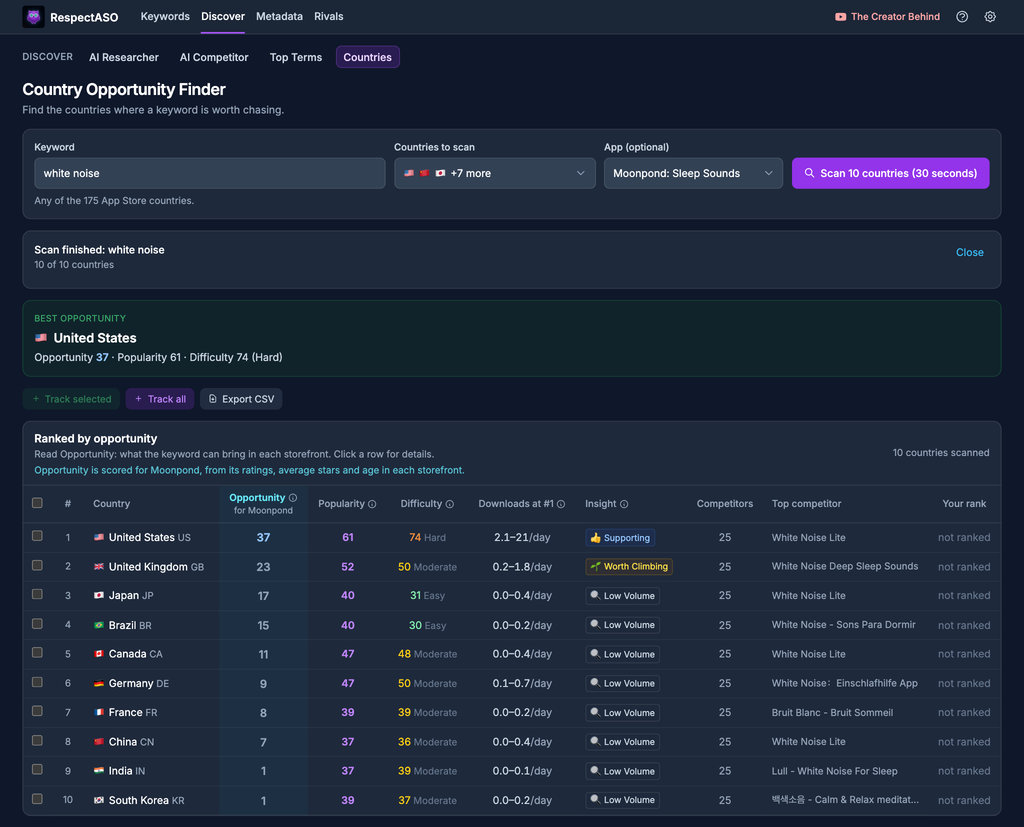
RespectASO's Country Opportunity Finder ranks the storefronts you pick for any keyword
Find the Best Keywords for Australia
See which keywords your app can win in the Australia App Store: RespectASO scores the popularity and difficulty of any keyword there, free on your Mac.