Singapore App Store
App Store Optimization for Singapore: The Complete ASO Guide
ASO guide for the Singaporean App Store. Multilingual keyword strategy for English and Chinese, Southeast Asian market hub insights, and metadata tips.
The Singaporean App Store: Asia's Multilingual Premium Hub
Singapore, with just under 6 million people, is one of the wealthiest and most digitally advanced nations in the world. Despite its tiny land area and population, Singapore generates disproportionate App Store revenue per capita: its affluent, tech-savvy population embraces mobile apps across all categories. For indie developers, Singapore offers a premium English-speaking Asian market with unique multilingual optimization opportunities.
Singapore's position as Asia's financial and tech hub means its App Store is a crossroads of cultures. The population speaks English, Mandarin, Malay, and Tamil, creating multilingual keyword opportunities that most developers overlook. An app that optimizes for Singapore's English locale while adding Chinese keywords captures traffic from one of the world's most linguistically diverse markets.
User Behavior and Market Characteristics
Singaporean users are highly connected: the city-state has near-universal smartphone penetration and among the fastest mobile internet speeds globally. Mobile payments (via PayNow, GrabPay, DBS PayLah!) are mainstream. App usage spans all categories, with particular strength in Finance, Food & Drink (food delivery and hawker center discovery), Shopping, Travel, and Productivity.
Premium pricing works well in Singapore: users are accustomed to paying for quality services and have high disposable income. Singapore also serves as a testbed for Southeast Asian expansion, with many regional apps launching in Singapore first.
Seasonal Patterns
- Chinese New Year / 春节 (January/February): Singapore's biggest holiday. Red envelope gifts (now often digital), family gatherings, and new device activations peak. Finance and Lifestyle apps see strong demand.
- National Day (August 9): Singapore's Independence Day celebration with themed content and promotional activity.
- Great Singapore Sale (June–August): Extended shopping season driving Shopping and deals app use.
- Year-end holidays (December): School holidays and Christmas celebrations drive app downloads and device activations.
- Ramadan (dates vary): Important for Singapore's Malay-Muslim community, driving food and prayer app demand.
- Deepavali (October/November): The Hindu Festival of Lights is a national holiday in Singapore.
Language and Localization
Singapore's App Store uses English (en-SG) as its primary locale, but Singapore is officially quadrilingual: English, Mandarin Chinese, Malay, and Tamil. This creates a fascinating ASO landscape.
Singlish and Singaporean English
- Official English base: Singapore uses British English spelling conventions (colour, organise, centre). Your
en-SGmetadata should follow British English conventions, similar to the UK and Australia. - Local vocabulary: Uniquely Singaporean terms include "HDB" (public housing), "hawker" (food center), "EZ-Link" (transit card), "MRT" (metro), "COE" (vehicle ownership certificate). Apps serving local needs should include these Singapore-specific terms.
- Informal Singlish: Colloquial Singlish terms ("shiok," "kiasu," "tabao") are culturally relevant but less likely to appear in formal App Store searches. Stick to standard English with Singapore-specific vocabulary.
Multilingual Keyword Opportunity
Singapore's Chinese-speaking population (approximately 75% ethnic Chinese) searches in both English and Chinese. Including Simplified Chinese keywords (Singapore uses Simplified Chinese, like mainland China) in your keyword field can capture an entire additional search audience. Keywords like "记账" (bookkeeping), "健身" (fitness), "食谱" (recipes) are searched by Singaporean Chinese-speakers alongside their English equivalents.
Competition Landscape
Singapore's App Store has moderate competition from regional players (Grab, Shopee, Lazada, Carousell) and global apps. However, English-language keyword competition is lower than in the US, UK, or Australia because Singapore's small population attracts less ASO attention from international developers. Chinese-language keywords face even less competition.
Keyword difficulty in Singapore typically runs 15–25 points lower than in the US for English keywords and significantly lower for Chinese keywords. Singapore's unique position exists at the intersection of English and Chinese search universes, and developers who optimize for both get coverage that most competitors can't match.
Keyword Research Strategies for Singapore
1. Optimize English with Singapore Specifics
Start with your standard English keywords but add Singapore-specific terms. If your app relates to housing, include "HDB." For transit, include "MRT" and "EZ-Link." For food, include "hawker." These locally specific terms have respectable search volume with almost zero international competition.
2. Add Simplified Chinese Keywords
The biggest untapped opportunity in Singapore ASO is Simplified Chinese keywords. Most English-language app developers never consider adding Chinese to their Singapore keyword field. Include the Chinese equivalents of your core keywords: this effectively doubles your keyword coverage in Singapore with near-zero additional competition.
3. Compare Singapore with Australia and UK
Use the Country Opportunity Finder to compare English keywords across Singapore, Australia, and the UK. All three use similar English, but competition levels differ significantly. Singapore often shows the best opportunity scores among premium English-speaking markets.
4. Target Financial Keywords
Singapore's financial hub status creates strong demand for finance-related keywords. "CPF" (Central Provident Fund), "investment," "portfolio," "savings," "SG bonds": financial keywords in Singapore are high-value and often less competitive than in other financial centers.
Metadata Optimization for the Singaporean Store
Title (30 Characters)
Use standard English with optional Singaporean context: "BudgetPal: Expense Tracker" (26 characters) works perfectly for Singapore. If your app has Singapore-specific features, reference them: "HawkerPay: SG Food Tracker" (26 characters).
Subtitle (30 Characters)
English keyword phrase for Singapore: "Track spending & save money" (27 characters). Standard, effective, and natural for the Singaporean English audience.
Keyword Field (100 Characters)
This is where Singapore's multilingual opportunity shines. Allocate approximately 60–70 characters to English keywords (including Singapore-specific terms like "HDB," "MRT," "CPF") and 30–40 characters to Simplified Chinese keywords covering your core concepts. This split captures both English and Chinese search traffic, a strategy almost no competitor implements.
Common Mistakes
- Treating Singapore as just another English market. Singapore's English keyword field is an opportunity, but the multilingual keyword strategy (English + Chinese) is the real differentiator. Most developers miss the Chinese search opportunity entirely.
- Ignoring Singapore-specific vocabulary. "HDB," "MRT," "CPF," "EZ-Link," "NTUC": these acronyms and terms are part of daily Singaporean life. Apps that incorporate them show local relevance and capture searches that generic English misses.
- Using Traditional Chinese instead of Simplified. Singapore uses Simplified Chinese characters (like mainland China), not Traditional (like Taiwan). Using the wrong character set marks your localization as uninformed.
- Dismissing Singapore due to small population. Singapore's per-user revenue is among the highest in Asia. The combination of high spending, low competition, and multilingual keyword opportunities makes Singapore one of the most efficient markets to optimize for.
- Missing cultural calendar diversity. Singapore celebrates Chinese New Year, Hari Raya (Eid), Deepavali, and Christmas. Not accounting for this multicultural calendar misses multiple seasonal engagement opportunities.
How RespectASO Helps in the Singaporean Market
RespectASO supports Singapore as one of its 175 storefronts. Score English and Chinese keywords on popularity (1–100), difficulty (1–100), and opportunity (0–100). Compare English-only performance against mixed English-Chinese keyword sets to quantify the multilingual advantage.
Search a whole list of keywords at once to evaluate English terms, Chinese equivalents, and Singapore-specific vocabulary. The Country Opportunity Finder positions Singapore alongside Australia, UK, and other English-speaking markets, revealing Singapore's premium positioning with lower competition.
For a market where multilingual optimization turns a small country into a disproportionately effective ASO opportunity, RespectASO provides the data to make strategic keyword decisions across Singapore's unique linguistic landscape.
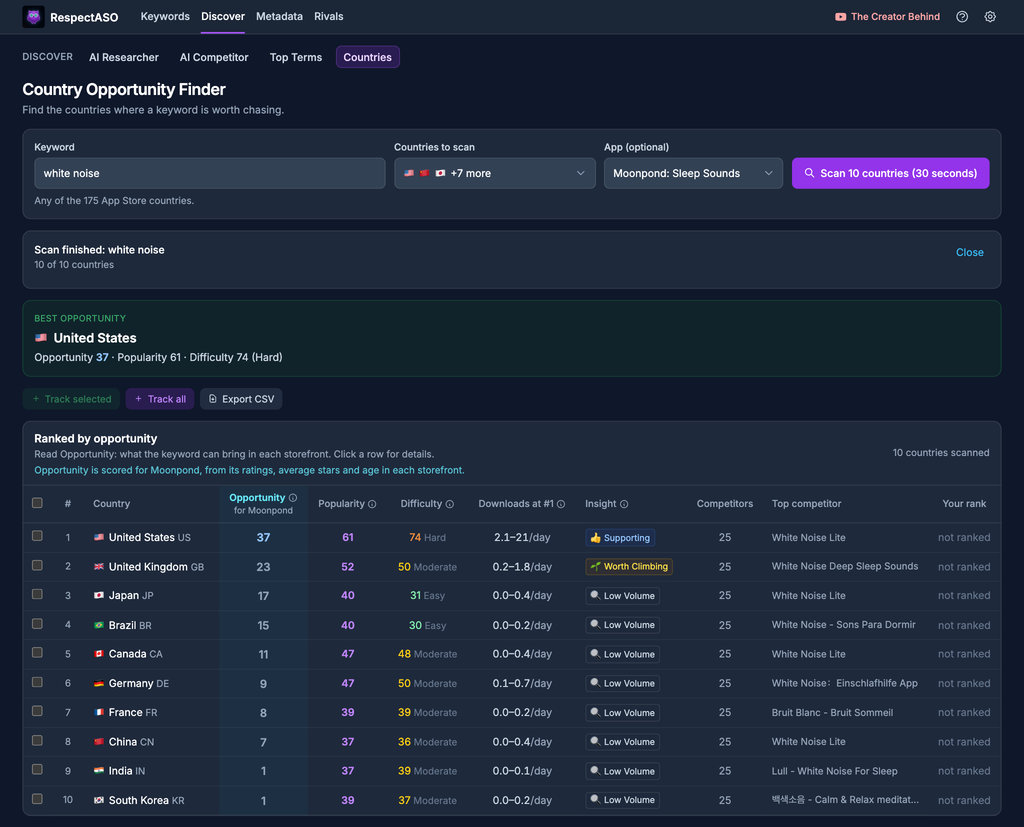
RespectASO's Country Opportunity Finder ranks the storefronts you pick for any keyword
Find the Best Keywords for Singapore
See which keywords your app can win in the Singapore App Store: RespectASO scores the popularity and difficulty of any keyword there, free on your Mac.