China App Store
App Store Optimization for China: The Complete ASO Guide
ASO guide for the Chinese App Store. Simplified Chinese keyword research, character-based optimization, and strategies for the world's largest mobile market.
The Chinese App Store: The World's Largest Mobile Market by Users
China's App Store is the largest in the world by number of users. With over 1.4 billion people and smartphone penetration still growing, the Chinese iOS market represents an enormous addressable audience. China consistently ranks in the top two globally for total App Store revenue, competing with the United States for the top position.
However, China is also the most unique App Store market. The regulatory environment, user behavior, competitive landscape, and discovery mechanisms all differ fundamentally from Western markets. For indie developers, China represents a high-potential but high-complexity opportunity that requires dedicated strategy rather than simple localization.
User Behavior and Revenue Potential
Chinese mobile users are deeply integrated with their smartphones in ways that exceed even South Korea. Mobile payment (WeChat Pay, Alipay) is ubiquitous. Super-apps handle everything from messaging to bill payment to food delivery. This mobile-first culture translates to strong App Store spending, particularly on games, education, and entertainment.
Revenue per user in China varies widely by category. The Games category is massive — China is the world's largest mobile gaming market by revenue. Education apps also perform exceptionally well, driven by intense academic culture and parental willingness to invest in learning tools. Lifestyle and Health & Fitness categories are growing rapidly as China's middle class expands.
Seasonal Patterns
- Chinese New Year (January/February): The most important holiday period. App downloads surge as millions receive new devices and exchange digital red envelopes. The dates shift annually (lunar calendar).
- Singles' Day (November 11): Originally an anti-Valentine's Day, it has become the world's largest online shopping event. Shopping app downloads and engagement skyrocket.
- Mid-Autumn Festival (September/October): Major traditional holiday with increased app usage for travel, messaging, and gift-giving.
- School year starts (September): Chinese schools begin the main academic year in September, driving Education app downloads.
- 618 Shopping Festival (June 18): JD.com's mid-year shopping event has become an industry-wide promotion period.
Language and Localization
The Chinese App Store uses Simplified Chinese (locale code zh-CN). This is distinct from Traditional Chinese used in Taiwan and Hong Kong. You need separate localizations for each.
Chinese Characters (Hanzi)
Chinese is written entirely in characters (汉字, hànzì). Each character is a syllable carrying semantic meaning, making Chinese extremely compact for keyword purposes. "健身" (fitness) is only 2 characters. "家庭记账" (household budgeting) is 4 characters. This efficiency means you can pack enormous keyword density into Apple's 30-character title and subtitle limits.
Pinyin and Input Methods
Chinese users type using pinyin (romanized pronunciation) input methods that convert to characters. This means users think in pinyin when entering search terms, and Apple's algorithm may match pinyin to characters. However, the final search query is in characters, so your metadata should contain characters — not pinyin. Including pinyin variants in your keyword field may provides marginal benefit for catching incomplete conversions.
Simplified vs. Traditional Chinese
Do not mix Simplified and Traditional characters in your China metadata. Simplified Chinese is standard in mainland China, and mixing scripts looks unprofessional. If you also target Taiwan, create a completely separate Traditional Chinese localization.
Vocabulary Differences
Chinese tech terminology sometimes diverges from common English-to-Chinese translations:
- "软件" (software) vs. "应用" (application/app) — Different contexts use different terms
- "手机" vs. "移动设备" — "mobile phone" (informal) vs. "mobile device" (formal)
- Internet slang — Chinese internet culture generates slang terms rapidly. These can be high-value keywords with low competition due to their novelty, but they also fade quickly
Competition Landscape
China's App Store is dominated by large Chinese tech companies: Tencent, Alibaba, ByteDance, Baidu, NetEase, and JD. These companies have massive user bases, deep pockets, and sophisticated ASO teams. Competing head-on with them for generic keywords is impractical for indie developers.
However, China's app ecosystem is not monolithic. Niche categories, tools, and specialized applications can find space between the giants. Difficulty for niche keywords in China can be surprisingly moderate because the giants focus on mass-market terms. Indie developers who target specific use cases with well-crafted Chinese metadata can find genuine Sweet Spot opportunities.
Regulatory Considerations
China has unique regulatory requirements for app distribution, including content review policies that can affect what types of apps are available on the Chinese App Store. Apple's curation in China reflects these requirements. Be aware that certain app categories and content types face additional scrutiny in the Chinese market.
Keyword Research Strategies for China
1. Research in Chinese Characters From the Start
Do not translate English keywords — research Chinese search behavior natively. Chinese users may describe the same concept using completely different framing than English speakers. "记账" (bookkeeping) is more commonly searched than "预算" (budget) for personal finance apps, even though "budget" is the preferred English term. Use RespectASO to evaluate actual Chinese keyword popularity and difficulty.
2. Leverage Character Density
Chinese characters pack more meaning per character than any other language. You can fit 15 meaningful Chinese keywords into the same space that holds 5 English keywords. Exploit this density in your keyword field by using short, precise character combinations.
3. Target Long-Tail Chinese Keywords
While head terms like "健身" (fitness) face massive competition, long-tail combinations like "居家健身计划" (home fitness plan) or "孕妇瑜伽" (prenatal yoga) have dramatically lower difficulty. Chinese long-tail keywords are still very compact — 4–6 characters for a highly specific phrase.
4. Compare China Against Taiwan and Other Asian Markets
Use RespectASO's Country Opportunity Finder to compare keyword opportunity across China, Taiwan, Japan, and South Korea. You may find that a keyword with extreme difficulty in China has excellent opportunity in Taiwan — or vice versa.
Metadata Optimization for the Chinese Store
Title (30 Characters)
Chinese character efficiency is your biggest asset. "智能记账: 家庭理财助手" (Smart Bookkeeping: Family Finance Assistant, 12 characters) packs enormous meaning into 12 characters, leaving 18 characters of budget unused. Use this space wisely — include your brand name and your two highest-value keywords.
Subtitle (30 Characters)
A concise, benefit-oriented Chinese phrase. Chinese app listings tend toward descriptive subtitles that explain functionality clearly. "每日收支记录与预算管理" (Daily income/expense tracking and budget management, 11 characters) tells users exactly what the app does.
Keyword Field (100 Characters)
Chinese character density means you can include a massive number of keywords in 100 characters — potentially 30–50 individual keyword terms. Use every character: synonyms, abbreviated forms, colloquial alternatives, and related long-tail phrases. This is where China's character efficiency pays the biggest dividends.
Common Mistakes in the Chinese Market
- Using Traditional Chinese characters for mainland China. Simplified Chinese is standard. Traditional characters look foreign to mainland users and may not match search queries.
- Relying on machine translation. Chinese machine translation has improved dramatically but still produces unnatural phrasing for marketing copy. Native speaker review is essential for title and subtitle.
- Ignoring the competitive reality. China's tech giants dominate certain categories completely. Honest assessment of where you can compete — and where you cannot — saves effort. Focus on niches between the giants.
- Not accounting for Chinese internet culture. The tone, style, and visual expectations of Chinese users differ from Western norms. Metadata that feels too "Western" can fail to connect. Study successful indie apps in the Chinese App Store for tone and style cues.
- Skipping China entirely. The regulatory and competitive complexity deters many developers, but the sheer market size means even a small slice of visibility translates to meaningful downloads. A well-localized presence in China can outperform multiple smaller markets combined.
How RespectASO Helps in the Chinese Market
RespectASO supports keyword research across all 175 App Store storefronts including China, giving you the same scoring system for Chinese keywords as English ones: popularity (1–100), difficulty (1–100), and opportunity (0–100). You can evaluate Simplified Chinese keyword candidates with data, not guesswork.
The Country Opportunity Finder places China in context alongside all other markets. Search any keyword and see how its opportunity compares across 175 storefronts — essential for deciding whether China merits localization investment for your specific app category.
The multi-keyword search (a whole list at a time, up to 1,000 keywords per search with Pro) lets you rapidly evaluate Chinese keyword candidates, synonyms, and long-tail variations. Combined with the five Insight tags, you can identify which Chinese keywords are genuinely achievable targets versus which are dominated by the major platforms.
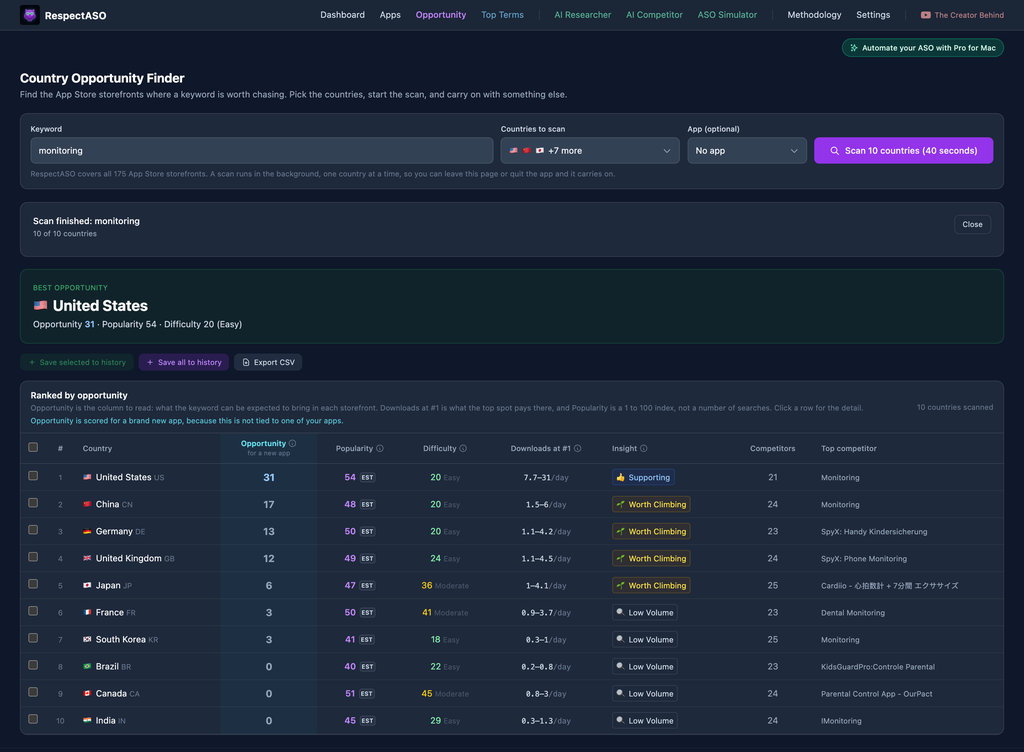
RespectASO's Country Opportunity Finder ranks the storefronts you pick for any keyword
Find the Best Keywords for China
Use RespectASO's Country Opportunity Finder to discover high-opportunity keywords in the China App Store.