South Korea App Store
App Store Optimization for South Korea: The Complete ASO Guide
ASO guide for the South Korean App Store. Korean keyword research, Hangul optimization, competition analysis, and cultural considerations.
The South Korean App Store: Asia's Most Tech-Forward Mobile Market
South Korea is one of the most digitally advanced countries on earth, and its App Store reflects that intensity. With the world's fastest average internet speeds, near-universal smartphone penetration, and a population of 52 million people deeply integrated with mobile technology, South Korea is a premier App Store market that most Western developers overlook.
South Korean users spend aggressively on mobile apps, particularly games and lifestyle services. The country ranks consistently in the top five globally for App Store revenue per capita, making it one of the highest-value localization targets in Asia after Japan.
User Behavior and Revenue Potential
South Koreans live on their phones. Mobile commerce, mobile banking, and mobile entertainment are not supplementary activities; they are the primary way most Koreans interact with digital services. KakaoTalk (Korea's dominant messaging platform) has over 95% market penetration, and its ecosystem of integrated services shapes how Koreans discover and evaluate apps.
Revenue per user is exceptionally high. Korean users are comfortable with in-app purchases, subscriptions, and premium app pricing. The Games category dominates revenue (Korea is one of the world's largest mobile gaming markets), but Lifestyle, Health & Fitness, and Education apps also see strong spending.
Seasonal Patterns
Korea's seasonal calendar includes distinct peaks:
- Lunar New Year (Seollal, January/February): Major holiday period, app downloads spike alongside gift-giving.
- School year start (March): Korean schools begin in early March, driving education and study app downloads.
- Chuseok (September/October): Korea's harvest festival and major holiday, comparable to Thanksgiving. Travel and lifestyle app usage peaks.
- November (Suneung): Korea's national college entrance exam. The entire country revolves around this event. Study aid and stress management apps see massive demand in the weeks before.
- December–January: End-of-year shopping and New Year's resolutions drive the familiar download surge.
Language and Localization
Korean (locale code ko-KR) uses the Hangul alphabet, a phonetic writing system that is elegant and systematic but entirely distinct from Latin, Chinese, or Japanese scripts.
Hangul: The Efficient Alphabet
Hangul is a phonetic script with a fixed set of characters arranged in syllable blocks. Unlike Japanese (which requires three writing systems), Korean uses one script system consistently. This simplifies keyword strategy compared to Japan or China: you do not need to target the same keyword in multiple script forms.
However, Hangul syllable blocks are compact: "가계부" (household ledger / budget app) is only 3 characters. This density means you can pack more keyword meaning into Apple's 30-character title and subtitle limits than in English.
Konglish and English Loanwords
Korean absorbs English words extensively, writing them in Hangul phonetically, a phenomenon called "Konglish":
- "앱" (aep): app
- "피트니스" (piteuneseu): fitness
- "다이어트" (daieoteu): diet
- "타이머" (taimeo): timer
- "캘린더" (kaellindeo): calendar
Include both the Konglish (Hangul) form and the straight English form in your keyword field. Korean users frequently search using either form, and Apple's search index treats them as separate tokens.
Formal vs. Informal Register
Korean has distinct formal and informal speech levels. App metadata typically uses the informal but polite register (해요체, haeyo-che). Using overly formal language makes your app listing feel corporate and stiff; using too casual language can seem unprofessional. Having a native Korean speaker review your metadata is important.
Competition Landscape
South Korea's competitive dynamics differ significantly from Western markets. Korean tech giants Kakao and Naver dominate many app categories through their integrated platform ecosystems. Samsung also has a strong native app presence. In categories where these platforms compete directly, indie developers face steep headwinds.
However, Korea's platform concentration creates an opportunity in niches that the giants overlook. Specialized tools, creative apps, niche Productivity solutions, and indie games all compete in a less crowded tier below the platform apps. Keyword difficulty for non-platform-dominated terms is often lower than expected for a market this sophisticated.
The Localization Moat
Like Japan, Korea's language barrier creates a natural competitive filter. Most Western developers do not invest in Korean localization, which dramatically reduces the competitive field. For indie developers who do localize, the reward is access to high-spending users with far less competition than English-speaking markets.
Keyword Research Strategies for South Korea
1. Research Korean and Konglish Variants Together
For every target keyword, research both the native Korean term and the Konglish variant. Use RespectASO's multi-keyword search to evaluate all the variants at once. "다이어리" (diary) and "일기" (diary/journal) might have very different popularity and difficulty profiles.
2. Target Education and Study Keywords
Korea's education-obsessed culture means study, learning, and academic keywords have unusually high search volume compared to other markets. "공부" (study), "영어" (English), "시험" (exam): these keywords have high popularity and present genuine opportunities, especially around the Suneung exam period.
3. Include English Terms in the Keyword Field
Korean users frequently search in English, especially younger demographics. Include relevant English keywords in your Korean localization's keyword field. They face minimal competition in the Korean store because most English-language developers are not targeting Korea specifically.
4. Use the Country Opportunity Finder
Compare Korea against Japan, Taiwan, and other Asian markets to understand where your target keywords have the best opportunity. Korea's compact but high-spending market often offers better opportunity profiles than Japan for non-gaming categories.
Metadata Optimization for the Korean Store
Title (30 Characters)
Hangul's compact syllable blocks give you excellent character efficiency. "플래너: 일정관리 앱" (Planner: Schedule Management App, 12 characters) conveys rich meaning in a fraction of the character budget. Use your brand name plus the most important Korean keyword.
Subtitle (30 Characters)
A benefit-oriented Korean phrase. Korean subtitle conventions favor descriptive language explaining what the app does, not tagline-style marketing. "매일 습관 추적과 목표 달성" (Daily habit tracking and goal achievement) works better than a clever but vague tagline.
Keyword Field (100 Characters)
Fill with: Konglish variants, pure Korean synonyms, English terms, abbreviations, and related but less obvious keywords. Hangul's compact nature lets you fit many keywords into 100 characters. Separate with commas and avoid duplicate words already in your title or subtitle.
Common Mistakes in the Korean Market
- Translating from Japanese instead of localizing for Korean. Japan and Korea have very different languages despite geographic proximity. If you have Japanese metadata, do not adapt it for Korean; start fresh with Korean keyword research.
- Ignoring Konglish. Korean users search for English loanwords in Hangul phonetic form. Missing these variants means missing a significant portion of searches.
- Using wrong speech register. Korean's honorific system means the wrong formality level immediately signals "not made for Korean users." Have a native speaker approve your metadata.
- Overlooking Korea because of platform dominance. Yes, Kakao and Naver are formidable, but they do not cover every niche. The space between platform apps is where indie developers thrive in Korea.
- Not accounting for exam season. The weeks before and after Suneung (November) and university exam periods are peak moments for education, wellness, and focus-related apps. Time your metadata updates accordingly.
How RespectASO Helps in the Korean Market
RespectASO supports keyword research across all 175 App Store storefronts including South Korea. Evaluate Korean keywords (in Hangul, Konglish, or English) with the same scoring system: popularity (1–100), difficulty (1–100), and opportunity (0–100).
The multi-keyword search is essential for Korean research: evaluate native Korean terms, Konglish variants, and English alternatives in a single batch. The Country Opportunity Finder positions Korea within the broader Asian market landscape, helping you decide whether to localize for Korea, Japan, both, or prioritize one over the other based on actual keyword data.
As a privacy-focused desktop application, RespectASO keeps your Korean keyword strategy confidential. In a market where localization investment is your competitive moat, protecting your keyword research from cloud-based aggregation is a strategic advantage.
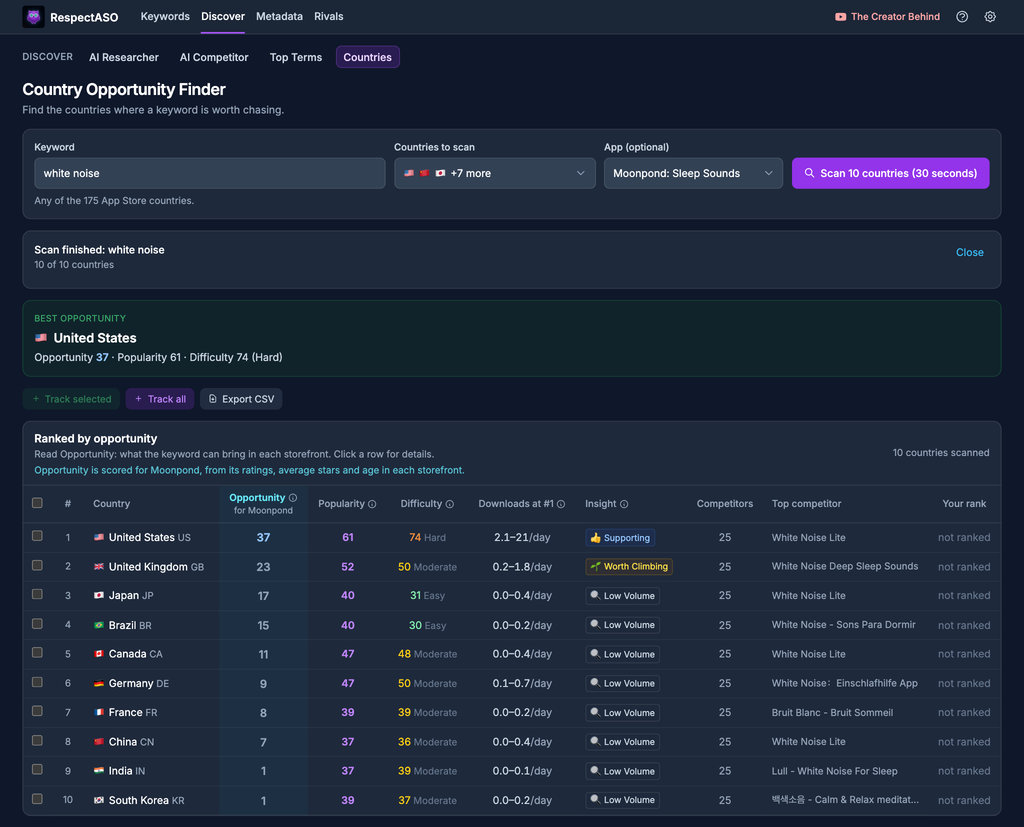
RespectASO's Country Opportunity Finder ranks the storefronts you pick for any keyword
Find the Best Keywords for South Korea
See which keywords your app can win in the South Korea App Store: RespectASO scores the popularity and difficulty of any keyword there, free on your Mac.