Taiwan App Store
App Store Optimization for Taiwan: The Complete ASO Guide
ASO guide for the Taiwanese App Store. Traditional Chinese keyword research, differences from Simplified Chinese, and metadata optimization strategies.
The Taiwanese App Store: Traditional Chinese Gateway to the Chinese-Speaking World
Taiwan, with approximately 24 million people, is a highly developed, tech-savvy market that uses Traditional Chinese (zh-TW), a distinct writing system from the Simplified Chinese used in mainland China. For indie developers, Taiwan offers a premium market with high iPhone penetration, strong purchasing power, and a clear path to reaching Traditional Chinese readers in Hong Kong and overseas Chinese communities worldwide.
Taiwan's tech ecosystem is world-class: the island is home to TSMC, Foxconn, ASUS, and HTC. This tech heritage produces a sophisticated, demanding user base that expects polished, well-localized apps. Developers who invest in Traditional Chinese localization access a premium market with less competition than Japan or South Korea.
User Behavior and Market Characteristics
Taiwanese users are highly engaged smartphone consumers with one of the highest iPhone market shares in Asia. Mobile payments, food delivery, and social communication apps are deeply embedded in daily life. LINE is the dominant messaging platform (unlike WeChat in mainland China), and its ecosystem influences how Taiwanese users discover and share apps.
Key categories include Food & Drink (Taiwan's incredible food culture drives strong app demand), Finance (mobile banking and investment), Shopping (e-commerce), Travel, and Entertainment.
Seasonal Patterns
- Lunar New Year / 農曆新年 (January/February): Taiwan's most important holiday. Extended family gatherings, red envelope gifting, and new device activations. Finance and Lifestyle apps see strong demand.
- Double 11 / 雙十一 (November 11): The global Singles' Day shopping event is hugely popular in Taiwan. Shopping apps and deal-finding tools surge.
- Mid-Autumn Festival / 中秋節 (September/October): BBQ season in Taiwan, a unique cultural tradition tied to this holiday.
- School season (September): College and school starting drive Education and Productivity demand.
- Summer vacation (July–August): Travel, Entertainment, and Photo & Video apps peak during school break.
Language and Localization
Taiwan uses Traditional Chinese (繁體中文, zh-TW), which has a completely different character set from Simplified Chinese (zh-CN) used in mainland China. This distinction is critical for ASO: Traditional and Simplified Chinese are separate keyword indices with no cross-matching.
Traditional vs. Simplified Chinese
- Different characters: "計算機" (Traditional, calculator) vs. "计算机" (Simplified). The same concept uses visually different characters. You must optimize separately for each.
- Different vocabulary: Beyond character differences, Taiwan and mainland China use different words: "軟體" (Traditional, software) vs. "软件" (Simplified); "影片" (Traditional, video) vs. "视频" (Simplified).
- Hong Kong overlap: Hong Kong also uses Traditional Chinese (
zh-HK). While Hong Kong vocabulary has some differences from Taiwanese Mandarin, the character set overlap is significant. Good Taiwanese Traditional Chinese metadata partially covers Hong Kong.
Traditional Chinese Characteristics for ASO
- Character density: Like Simplified Chinese, Traditional Chinese packs tremendous meaning per character. "記帳" (bookkeeping/expense tracking) is just 2 characters. This density means your 100-character keyword field can contain far more concepts than in alphabetic languages.
- Zhuyin (Bopomofo) input: Taiwanese users type using Zhuyin (ㄅㄆㄇㄈ), a phonetic system unique to Taiwan. This input method means users search by phonetic sounds, and homophone characters may be entered. Consider including common homophone variants in keywords.
- Mixed English usage: Taiwanese users, especially younger demographics, mix English terms into daily language. "App," "podcast," "Wi-Fi," "OK" are used directly. English brand names are common search terms.
Competition Landscape
Taiwan's App Store has moderate competition from local apps (PChome, Shopee Taiwan, LINE-related services, 台灣大車隊 for taxi) and Japanese apps (many Japanese apps are popular in Taiwan due to cultural affinity). International apps often provide Simplified Chinese but skip Traditional Chinese, creating a gap that developers with Traditional Chinese metadata can exploit.
Keyword difficulty in Taiwan is typically 20–30 points lower than in the US and often lower than in Japan or South Korea. Traditional Chinese keywords see less competition than Simplified Chinese because Taiwan's smaller market size attracts fewer optimizer efforts. This positions Taiwan as one of the most accessible Asian markets for ASO.
Keyword Research Strategies for Taiwan
1. Use Traditional Chinese Characters
If you've already localized for mainland China, don't assume Simplified Chinese works for Taiwan. Convert to Traditional characters AND adjust vocabulary: "軟體" (not "软件"), "影片" (not "视频"), "網路" (not "网络"). Each difference represents a separate keyword opportunity in the Traditional Chinese index.
2. Include Taiwanese-Specific Vocabulary
Taiwan has unique vocabulary: "捷運" (MRT/metro, used only in Taiwan), "便利商店" (convenience store, a cultural institution), "機車" (scooter, Taiwan's ubiquitous transport). These Taiwan-specific terms have strong search volume with minimal international competition.
3. Mix Traditional Chinese and English
Include both Traditional Chinese keywords and English equivalents. Taiwanese users search in both: "預算" (budget) and "budget," "健身" (fitness) and "fitness." The English terms in Taiwan's keyword field face almost zero competition from English-speaking market optimizers.
4. Compare Taiwan with China and Japan
Use the Country Opportunity Finder to compare your keywords across Taiwan, China, and Japan. Taiwan often shows the best opportunity scores among East Asian markets: lower competition than both China and Japan, with premium user purchasing power.
Metadata Optimization for the Taiwanese Store
Title (30 Characters)
Traditional Chinese character density is your advantage: "BudgetPal: 記帳與預算管理" (approximately 16 characters + spaces; "BudgetPal: Bookkeeping & budget management"). A few Chinese characters convey what would take many English words.
Subtitle (30 Characters)
Focus on your primary Taiwanese keyword: "輕鬆管理每日開銷" (8 characters; "Easily manage daily expenses"). Traditional Chinese subtitles can pack significant meaning into the character limit.
Keyword Field (100 Characters)
Maximize Traditional Chinese's character density. Each character is a potential keyword. Include: core Traditional Chinese terms ("記帳," "預算," "開銷," "儲蓄"), English equivalents ("budget," "tracker"), Taiwan-specific terms ("捷運," "悠遊卡"), and two-character keyword combinations that capture related searches. 100 characters in Traditional Chinese can cover more concepts than in any alphabetic language.
Common Mistakes
- Using Simplified Chinese for Taiwan. This is the equivalent of using Portuguese for a Spanish audience: related but wrong. Simplified characters mark your app as "not for Taiwan" to Taiwanese users. Always use Traditional Chinese (繁體中文) for the
zh-TWlocale. - Using mainland Chinese vocabulary. Even with correct Traditional characters, mainland vocabulary ("视频" written as "視頻" instead of the Taiwanese "影片") signals unfamiliarity with the Taiwanese market.
- Ignoring LINE integration. LINE is the dominant social platform in Taiwan. Apps that integrate with or reference LINE services have cultural relevance that WeChat-focused apps don't.
- Missing Lunar New Year optimization. Lunar New Year is Taiwan's biggest holiday and peak new-device activation period. Not preparing optimized metadata for this window misses Taiwan's largest download opportunity.
- Treating Taiwan and Hong Kong as identical. While both use Traditional Chinese, vocabulary differences exist ("捷運" is MRT in Taiwan; "港鐵" is MTR in Hong Kong). Tailored metadata for each market outperforms one-size-fits-all Traditional Chinese.
How RespectASO Helps in the Taiwanese Market
RespectASO supports Taiwan as one of its 175 storefronts. Score Traditional Chinese and English keywords on popularity (1–100), difficulty (1–100), and opportunity (0–100). The data shows Taiwan's favorable competitive landscape relative to other Asian markets.
Search a whole list of keywords at once to evaluate Traditional Chinese terms, English variants, and Taiwan-specific vocabulary. The Country Opportunity Finder positions Taiwan alongside China, Japan, and South Korea, revealing how Traditional Chinese keywords compare across East Asia.
For a premium Asian market where Traditional Chinese localization provides both a competitive moat and a gateway to the broader Traditional Chinese-reading audience, RespectASO gives you the data to maximize your keyword impact in one of Asia's most accessible and profitable App Store markets.
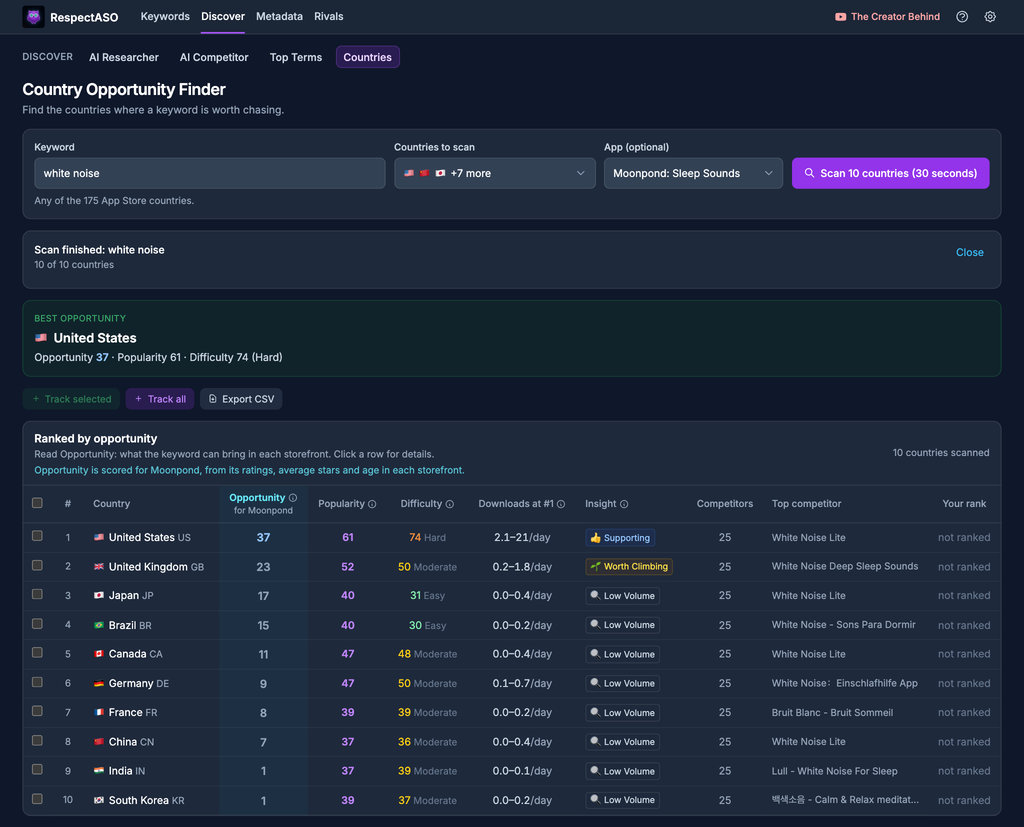
RespectASO's Country Opportunity Finder ranks the storefronts you pick for any keyword
Find the Best Keywords for Taiwan
See which keywords your app can win in the Taiwan App Store: RespectASO scores the popularity and difficulty of any keyword there, free on your Mac.