Netherlands App Store
App Store Optimization for Netherlands: The Complete ASO Guide
ASO guide for the Dutch App Store. Dutch keyword research, compound word strategies, and metadata optimization for the Netherlands market.
The Dutch App Store: A Small, Wealthy, and Highly Digital Market
The Netherlands, with approximately 17.5 million people, is one of Europe's most digitally advanced and prosperous nations. Dutch internet penetration exceeds 97%, smartphone adoption is near-universal, and the population is among the most willing to pay for digital services in Europe. For indie developers, the Netherlands offers a premium European market with low keyword competition and a population that reads English fluently but still searches in Dutch.
The Dutch market has an interesting ASO dynamic: while the population's English proficiency is among the highest in the world (often compared to Scandinavian levels), Dutch users still prefer and frequently search in their native language. Developers who dismiss Dutch localization because "everyone speaks English" miss a meaningful competitive advantage.
User Behavior and Market Characteristics
Dutch users are pragmatic, quality-conscious, and digitally native. The Netherlands has a strong fintech and e-commerce culture: iDEAL (the dominant online payment system), Tikkie (peer payment), and mobile banking apps are used by nearly everyone. The Dutch are also cycling obsessed, fitness-conscious, and environmentally aware, which shapes app category demand.
Key categories include Finance (iDEAL/Tikkie ecosystem), Health & Fitness (cycling culture is central), Weather (the Dutch obsess over weather), Navigation, Food & Drink, and Travel.
Seasonal Patterns
- Sinterklaas (December 5): The Netherlands' primary gift-giving holiday, ahead of Christmas. Gift-related shopping, children's apps, and wish list apps peak.
- Christmas / Kerst (December 25–26): A secondary holiday (after Sinterklaas) with family gatherings. Some new device activations.
- King's Day / Koningsdag (April 27): National celebration with markets, festivals, and orange everywhere. Entertainment and Lifestyle apps see seasonal engagement.
- Summer holidays (July–August): Dutch families vacation extensively. Travel, Navigation, and Photo & Video apps peak.
- Back to school (September): Education and Productivity app demand increases.
- Eredivisie football (August–May): Sports apps follow the Dutch football calendar.
Language and Localization
Dutch (nl-NL) is a West Germanic language closely related to German and English. Dutch vocabulary shares many cognates with both languages, making it relatively accessible for English-speaking developers to understand (though proper localization still requires native speakers).
Dutch Language Characteristics for ASO
- Compound words: Like German, Dutch creates compound nouns: "caloriënteller" (calorie counter), "huishoudboekje" (household budget book), "trainingsschema" (training schedule). These compounds are natural search terms with low competition.
- Special characters: Dutch uses limited special characters: ë and ï (trema/diaeresis) separate vowels, as in "België" (Belgium), "financiën" (finances). The trema is important for correct Dutch but Apple's search handles variations.
- Diminutives (-je, -tje): Dutch uses diminutive suffixes extensively: "boekje" (little book/booklet), "appje" (little app, colloquial for a quick app). Some diminutive forms appear in searches and carry cultural warmth.
- English mixed in: Dutch freely adopts English words: "app," "fitness," "workout," "budget," "online," "design." These English terms are valid Dutch search terms and appear in Dutch sentences naturally.
Dutch vs. Flemish
Dutch is also spoken in Flanders (northern Belgium), with approximately 6.5 million additional speakers. Belgian Dutch (Flemish) shares the written standard with Netherlands Dutch but has some vocabulary differences. Apple's Belgian App Store uses the same nl locale. Keywords that work in the Netherlands largely work for Flanders too, giving you access to a combined audience of ~24 million Dutch speakers.
Competition Landscape
The Netherlands has moderate domestic app competition (ING, Rabobank for finance; Buienradar for weather; Albert Heijn for groceries; NS for trains) but low international competition for Dutch-language keywords. Most global apps are present in the Netherlands but run with English-only metadata, relying on Dutch English proficiency. This gap is where Dutch localization provides a ranking advantage.
Keyword difficulty in the Netherlands is typically 20–30 points lower than in the US. Dutch compound keywords are particularly low-competition, because most international developers don't target them. Combined with the Netherlands' premium user base, this makes Dutch a high-ROI localization investment.
Keyword Research Strategies for the Netherlands
1. Target Dutch Compound Keywords
Dutch compounds are valuable, low-competition keywords: "uitgavenbeheer" (expense management), "fietsroute" (cycling route), "boodschappenlijst" (grocery list), "weersverwachting" (weather forecast). These natural Dutch terms are genuine searches that no English-only competitor targets.
2. Balance Dutch and English
The Dutch use English terms frequently in tech and fitness contexts. Include both: "training" (works in both Dutch and English), "schema" (schedule, a Dutch word), "fitness," "budget" (same in Dutch and English). Use RespectASO to compare popularity of Dutch vs. English variants for each keyword.
3. Include Weather Keywords
The Dutch are famously weather-obsessed. "Weer" (weather), "regen" (rain), "buien" (showers), "temperatuur" (temperature): weather-related Dutch keywords have consistent, year-round demand with achievable difficulty scores.
4. Compare Netherlands with Germany
Use the Country Opportunity Finder to compare keywords across the Netherlands and Germany. Dutch and German share many cognates ("kalender," "budget," "training"), and insights from one market often inform the other. Germany's larger market may have higher difficulty for the same concept, making the Netherlands the easier entry point.
Metadata Optimization for the Dutch Store
Title (30 Characters)
Dutch compound words help with efficiency: "BudgetPal: Uitgavenbeheer" (25 characters, "expense management"). If the compound is too long, split into short Dutch words: "BudgetPal: Geld & Uitgaven" (26 characters, "Money & Expenses").
Subtitle (30 Characters)
Natural Dutch phrase: "Makkelijk je budget bijhouden" (29 characters, "Easily keep your budget"). Dutch subtitles should sound natural: informal, friendly Dutch connects better than formal language.
Keyword Field (100 Characters)
Mix Dutch compounds, English terms, and short Dutch words. Include: compound keywords ("uitgavenbeheer," "spaardoel"), English equivalents ("budget," "tracker," "savings"), Dutch verbs ("sparen" = save, "bijhouden" = track), and cycling-related terms if relevant ("fiets," "route," "rit"). The Dutch-Flemish combined audience of ~24 million makes this keyword field serve a meaningful market.
Common Mistakes
- Assuming Dutch users will just use English. While many Dutch users can read English, they still search in Dutch for many app categories. Dutch metadata provides a ranking advantage over English-only competitors for Dutch-language searches.
- Ignoring cycling culture. The Netherlands is the world's cycling capital. Fitness, navigation, and commuting apps that don't include Dutch cycling keywords miss a massive, distinctive demand segment.
- Conflating Dutch with German. While related, Dutch and German are different languages. "Ausgaben" (German for expenses) is not correct Dutch ("uitgaven"). Cross-language mistakes are noticed by native speakers.
- Missing Sinterklaas timing. The primary Dutch gift-giving holiday is December 5, not December 25. Apps targeting the holiday season need to be optimized for November–December 5 to capture the Sinterklaas peak.
- Forgetting about Belgium. The Flemish market adds ~6.5 million Dutch speakers. Keywords optimized for the Netherlands largely work for Belgian Dutch users too, making Dutch localization serve a larger combined audience.
How RespectASO Helps in the Dutch Market
RespectASO supports the Netherlands as one of its 175 storefronts. Score Dutch and English keywords on popularity (1–100), difficulty (1–100), and opportunity (0–100). The data reveals which keywords perform best in Dutch vs. English within the Netherlands market.
Search a whole list of keywords at once to compare Dutch compounds, English equivalents, and shared cognates. The Country Opportunity Finder positions the Netherlands alongside Germany, Scandinavia, and other European markets, showing where Dutch keywords offer the strongest opportunity.
For a premium European market where Dutch localization creates a meaningful edge over English-only competitors, RespectASO provides the quantitative data to allocate your keyword budget across the Dutch-English spectrum for maximum impact.
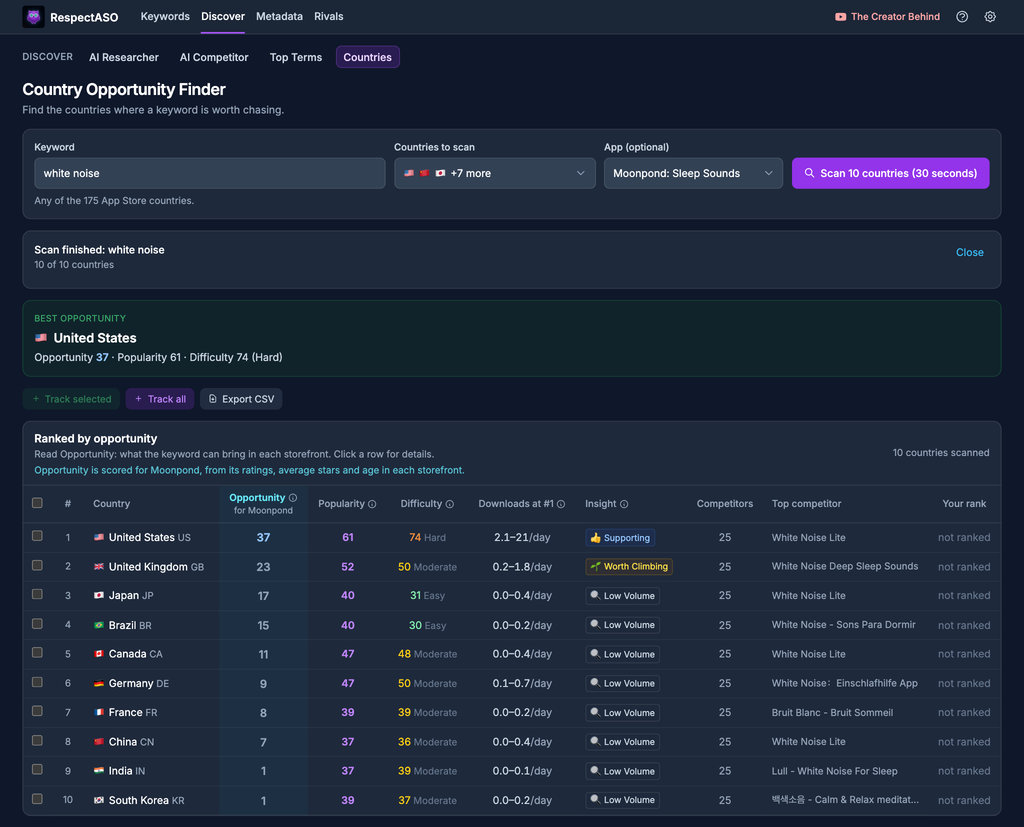
RespectASO's Country Opportunity Finder ranks the storefronts you pick for any keyword
Find the Best Keywords for Netherlands
See which keywords your app can win in the Netherlands App Store: RespectASO scores the popularity and difficulty of any keyword there, free on your Mac.