Indonesia App Store
App Store Optimization for Indonesia: The Complete ASO Guide
ASO guide for the Indonesian App Store, Southeast Asia's largest market. Indonesian keyword research, rapid growth insights, and metadata strategies.
The Indonesian App Store: Southeast Asia's Largest Digital Economy
Indonesia is the world's fourth most populous country with over 275 million people spread across more than 17,000 islands. It is Southeast Asia's largest economy and one of the world's fastest-growing mobile markets. For indie developers, Indonesia is an enormous user base, and most international developers never write Bahasa Indonesia metadata for it.
Unlike the Philippines where English keywords alone give reasonable traction, Indonesia requires Bahasa Indonesia localization for maximum impact. However, Bahasa Indonesia is considered one of the easiest Asian languages for English speakers to learn: it uses the Latin alphabet, has simple grammar, and borrows many English words.
User Behavior and Market Characteristics
Indonesia's mobile-first population has leapfrogged desktop computing. For many Indonesians, smartphones are their first and primary computing device. This has driven explosive growth in Finance (GoPay, OVO, Dana, ShopeePay have transformed payments), Shopping (Shopee and Tokopedia/TikTok Shop dominate e-commerce), Entertainment (gaming is massive), and Food & Drink (GoFood, GrabFood, ShopeeFood).
Education is a major growth category as Indonesia's young population (median age ~30) drives demand for learning and skills apps. Social Networking is also enormous: Indonesia has among the highest social media penetration rates globally.
Indonesian users are extremely price-sensitive. Free apps and freemium models dominate. In-app purchases are growing as digital payment infrastructure expands, but pricing must account for significantly lower purchasing power compared to Western markets.
Seasonal Patterns
- Ramadan and Eid al-Fitr (varies, ~30 days): As the world's most populous Muslim-majority country, Ramadan profoundly impacts app behavior. Shopping surges during the pre-Eid period, religious and meditation apps spike, and Food & Drink apps see altered patterns. This is the most important seasonal event for Indonesian ASO.
- Year-end holidays (December): Although Indonesia is Muslim-majority, Christmas and New Year drive significant consumer spending, especially in e-commerce.
- Harbolnas (12.12): Hari Belanja Online Nasional (National Online Shopping Day) on December 12 is Indonesia's biggest online shopping event, modeled after Singles' Day. Shopping and deal-finder apps surge.
- Back to school (July): The Indonesian school year typically starts in July, driving Education app demand.
- Independence Day (August 17): National celebrations drive themed content and promotions across apps.
Language and Localization
Bahasa Indonesia (Indonesian) is the sole official language and the lingua franca across the archipelago. While Indonesia has over 700 regional languages, Bahasa Indonesia is universally understood and used for all official and commercial purposes.
Why Bahasa Indonesia Localization Is Accessible
- Latin alphabet: No special characters, no diacritics, no script conversion needed. "Keuangan" (finance), "belanja" (shopping), "gratis" (free) are all standard Latin characters.
- No tones: Unlike Vietnamese or Thai, Bahasa Indonesia has no tonal system.
- Simple grammar: No gendered nouns (unlike French or German), no verb conjugations, no articles. "Aplikasi pengelola keuangan" (financial management app) has a straightforward word order.
- English loanwords: Many modern and tech terms are borrowed directly from English: "aplikasi" (application), "online," "download," "gratis" (free, borrowed via Dutch/Portuguese). These cognates make keyword research intuitive.
Indonesian Keyword Characteristics
- Affixed words: Indonesian uses prefixes and suffixes extensively: "belanja" (shop) → "berbelanja" (to shop) → "perbelanjaan" (shopping). Include both root words and common affixed forms in your keyword field.
- Informal abbreviations: Indonesians frequently abbreviate in text: "yg" (yang = which), "tdk" (tidak = no/not), "utk" (untuk = for). These informal forms appear in search queries.
- Compound descriptors: "Aplikasi pengatur keuangan" (financial management app), "aplikasi penghitung kalori" (calorie counting app). Indonesian descriptive compounds are clear and keyword-rich.
Competition Landscape
The Indonesian App Store is dominated by regional super-apps (Gojek, Grab, Shopee, Tokopedia) but outside their categories, many keyword niches are open to apps that localize. Most international apps available in Indonesia run with their default English or generic metadata without Indonesian localization.
That leaves room for apps that write their metadata in Bahasa Indonesia: an Indonesian keyword matches only apps localized for it, while the same idea in English competes with every English listing in the store. Measure your Indonesian candidates in RespectASO to see how hard each one is to rank for before you commit metadata to them.
Keyword Research Strategies for Indonesia
1. Start with Bahasa Indonesia Core Terms
Translate your app's core function into Indonesian: "keuangan" (finance), "kesehatan" (health), "pendidikan" (education), "produktivitas" (productivity), "kebugaran" (fitness). These root terms are your first search targets; measure each one's popularity and difficulty to see its Opportunity for your app.
2. Include Both Root Words and Affixed Forms
Indonesian's affix system means users search for both "belanja" and "berbelanja." Include root forms in your keyword field (they're shorter) and use affixed forms in your title or subtitle where they read naturally. The search algorithm often connects related forms, but explicit inclusion ensures coverage.
3. Leverage English-Indonesian Cognates
Many tech and modern terms exist in both English and Indonesian: "download," "online," "gratis," "aplikasi." Include both forms. A user might search "budget tracker" or "pelacak anggaran", and covering both maximizes reach without doubling your keyword count.
4. Compare with Regional Markets
Use the Country Opportunity Finder to compare Indonesian keyword opportunities against Vietnam, Philippines, Thailand, and Singapore. It ranks every storefront you pick by the Opportunity a keyword offers your app.
Metadata Optimization for the Indonesian Store
Title (30 Characters)
Use Indonesian to signal relevance: "DompetKu: Pengatur Keuangan" (27 characters, "MyWallet: Finance Manager"). Indonesian words tend to be multi-syllabic but the Latin script keeps character counts manageable. The 30-character title limit works well for Indonesian.
Subtitle (30 Characters)
Indonesian subtitle example: "Kelola uang dengan mudah" (25 characters, "Manage money easily"). Indonesian's no-article, no-conjugation grammar keeps phrases concise.
Keyword Field (100 Characters)
With 100 characters, Indonesian keywords pack efficiently: "keuangan,anggaran,tabungan,hemat,pengeluaran,belanja,gratis,uang,dompet,bayar,cicilan,investasi" (93 characters: 12 keywords covering finance, budget, savings, spending, shopping, free, money, wallet, payment, installment, investment). Indonesian's Latin script and lack of diacritics means every character is productive.
Common Mistakes
- Running English-only metadata. Unlike the Philippines or Singapore where English works natively, Indonesia requires Bahasa Indonesia for real organic reach. English-only metadata misses the majority of search behavior.
- Ignoring Ramadan seasonality. As the world's largest Muslim-majority country, Ramadan transforms Indonesian app behavior for 30+ days. Not preparing metadata for Ramadan-relevant keywords misses the market's single most important seasonal event.
- Confusing Bahasa Indonesia with Bahasa Melayu. Indonesian and Malay (Malaysia/Singapore) share roots but differ significantly in modern vocabulary. "Mobil" (car) in Indonesian vs. "kereta" in Malay, "ponsel" (phone) vs. "telefon." Use Indonesian-specific terms for the Indonesian store.
- Overcomplicating the language. Bahasa Indonesia is structurally simple for English speakers. Don't overthink it: root words with basic prefixes cover most search queries. "Gratis" (free), "mudah" (easy), "cepat" (fast).
- Dismissing Indonesia as "low value." With 275+ million people and rapidly growing digital payment infrastructure, Indonesia's total addressable market is enormous. Low per-user ARPU is offset by massive volume and growing monetization sophistication.
How RespectASO Helps in the Indonesian Market
RespectASO supports Indonesia as one of its 175 storefronts. Score Bahasa Indonesia and English keywords simultaneously on popularity (1-100), difficulty (1-100), and opportunity (0-100). The scores show how each Indonesian keyword compares with the same idea in your other markets.
Search a whole list of keywords at once to evaluate Indonesian terms, and use the Country Opportunity Finder to compare Indonesia with the other Southeast Asian storefronts you pick.
For the world's fourth most populous country where a few Indonesian keywords in your keyword field can unlock massive organic reach, RespectASO provides the specific scoring data to prioritize which Indonesian keywords deliver the best results.
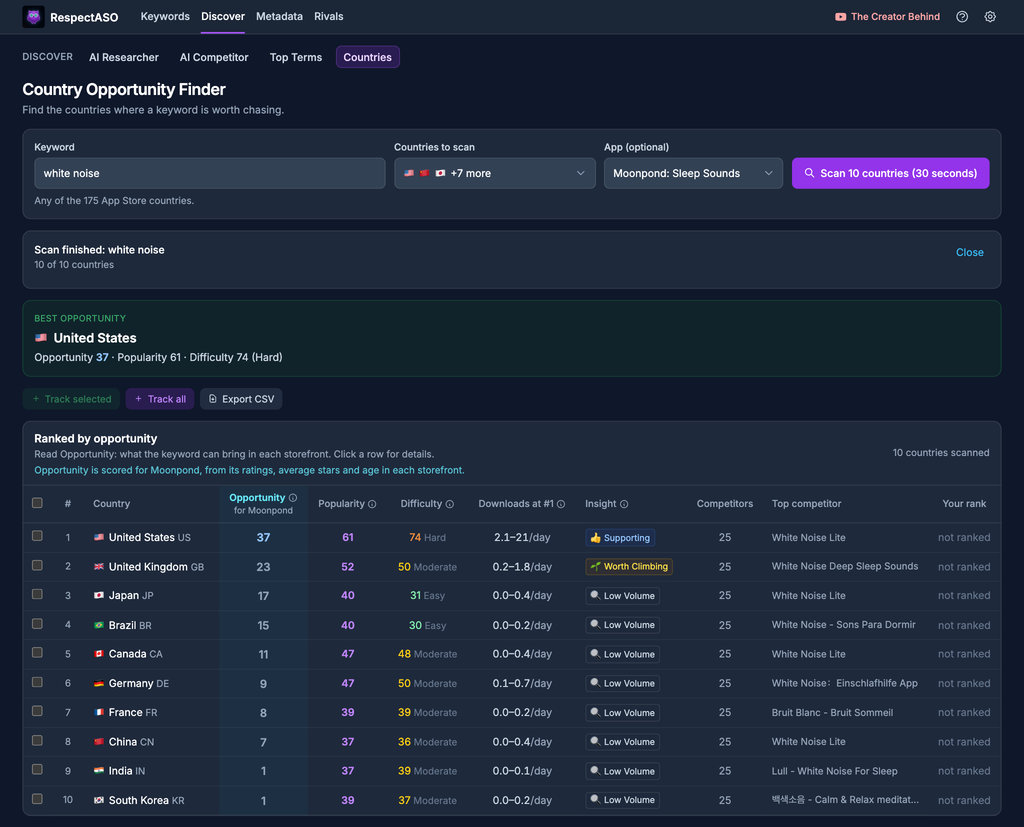
RespectASO's Country Opportunity Finder ranks the storefronts you pick for any keyword
Find the Best Keywords for Indonesia
See which keywords your app can win in the Indonesia App Store: RespectASO scores the popularity and difficulty of any keyword there, free on your Mac.