Thailand App Store
App Store Optimization for Thailand: The Complete ASO Guide
ASO guide for the Thai App Store. Thai keyword research with scriptless word boundaries, Southeast Asian growth trends, and metadata optimization.
The Thai App Store: A Script-Protected Southeast Asian Powerhouse
Thailand, with over 70 million people, is Southeast Asia's second-largest economy and one of the region's most digitally connected markets. Thai smartphone penetration rivals developed nations, and mobile apps are deeply integrated into daily life, from LINE messaging (Thailand's dominant chat platform) to food delivery, ride-hailing, and mobile banking. For indie developers, Thailand offers a compelling opportunity: a large, engaged mobile audience protected by the Thai script barrier that most international competitors never cross.
Thai script localization keeps out most of the competition that never writes it. Unlike the Philippines (English-speaking) or Indonesia (Latin-script language), Thailand requires a completely different writing system, and this is exactly what makes it valuable.
User Behavior and Market Characteristics
Thai users are highly engaged mobile consumers. LINE is the dominant messaging platform (far more important than WhatsApp or Messenger), and it functions as a super-app covering payments (LINE Pay/Rabbit LINE Pay), news, shopping, and social media. Any app strategy in Thailand must account for LINE's central role.
Key categories include Finance (mobile banking has transformed Thailand: PromptPay, KBank, SCB Easy), Shopping (Shopee, Lazada), Entertainment (gaming, streaming; Thailand is a major gaming market), Food & Drink (Grab, LINE MAN, Foodpanda), and Travel (Thailand's massive tourism industry drives both tourist-facing and local travel apps).
Thai users exhibit strong brand loyalty once they adopt an app. Getting initial downloads is the challenge, but retention rates are often higher than in more fickle Western markets.
Seasonal Patterns
- Songkran / Thai New Year (April 13-15): Thailand's biggest celebration. Travel, Entertainment, and social apps surge. Many Thais travel to their home provinces, so transportation and booking apps peak.
- Loy Krathong (November, full moon): Festival of lights drives photography, social, and event apps.
- High tourism season (November-February): Tourist-facing apps (translation, transportation, maps, food guides) see pronounced demand during Thailand's peak tourism period.
- School year start (May): Education app demand spikes as the Thai academic year begins.
- Shopping festivals (11.11, 12.12): E-commerce platforms drive massive promotional events aligned with Singles' Day and year-end shopping.
Language and Localization
Thai is the sole official language and the universal language of commerce, media, and daily life. Thai script is an abugida (consonant-vowel combination system) with 44 consonants, 15 vowels, and 4 tone marks. It has no spaces between words: phrases run together continuously.
Thai Script: The Localization Moat
- Unique writing system: Thai script is used only for the Thai language, creating a powerful localization barrier. Unlike Chinese characters (shared with Japan and Taiwan), Thai script is exclusively Thai. Competitors who don't localize simply don't appear in Thai-language searches.
- No word spacing: Thai text doesn't use spaces between words: "แอปจัดการเงิน" (money management app). The search algorithm must parse word boundaries. This means exact keyword matching is less predictable, but it also means Thai keywords capture broader intent.
- Tonal language: Thai has 5 tones, but tones are represented in script, not in romanization. For ASO purposes, you work with Thai script directly, since the tonal complexity is in the writing system itself.
- Extreme character density: Thai script packs meaning very densely. A 30-character Thai title can convey what requires 50+ characters in English. This makes the App Store character limits extremely generous for Thai metadata.
Thai Keyword Characteristics
- English loanwords in Thai script: Many tech terms are English words written in Thai: "แอป" (app), "ออนไลน์" (online), "ดาวน์โหลด" (download), "ฟรี" (free). Include both pure Thai terms and these transliterated English terms.
- Native Thai terms: "เงิน" (money), "สุขภาพ" (health), "อาหาร" (food), "เรียน" (study/learn), "งาน" (work/job): core category terms in native Thai.
- Classifier words: Thai uses classifiers (similar to Japanese counters) but these rarely appear in search queries. Focus on content words.
Competition Landscape
Thailand's App Store has strong local and regional competitors in key categories (LINE, Grab, Shopee, KBank), but outside those categories, many keyword niches are open to apps that localize. International apps that appear in the Thai store typically run English metadata: they rank for English searches but are invisible to Thai-language queries.
A Thai-language keyword matches only apps that wrote Thai metadata, while the same idea in English competes with every English listing in the store. Measure your Thai and English candidates side by side in RespectASO to see how hard each is to rank for.
The competitive landscape creates a clear two-tier strategy: use English keywords to capture the significant English-searching segment (tourists, expats, bilingual Thais), and use Thai keywords to dominate the much larger Thai-language search index.
Keyword Research Strategies for Thailand
1. Prioritize Thai-Script Core Keywords
Identify the Thai terms for your app's primary function. "บันทึกรายจ่าย" (expense tracker), "ออกกำลังกาย" (exercise), "สูตรอาหาร" (recipes): these Thai descriptors are the first keywords to measure for popularity and difficulty.
2. Include Transliterated English Terms
Thai users frequently search using English words written in Thai script. "แอป" (app), "ฟรี" (free), "ออนไลน์" (online) appear in many searches. These transliterated terms are short and efficient additions to your keyword field.
3. Also Include English Keywords
A significant portion of Thai users, especially younger, urban demographics, search with English terms. Include standard English keywords alongside Thai ones. The Thai App Store indexes both, and users commonly switch between English and Thai input methods.
4. Exploit Thai Script Density
Thai script's density means you can fit more meaning into the 100-character keyword field than in any European language. Where English might fit 10-12 keywords, Thai can accommodate 15-20 meaningful terms. Take full advantage of this: the keyword field is your single best localization investment for Thailand.
Metadata Optimization for the Thai Store
Title (30 Characters)
Thai script's density gives you tremendous flexibility. "บันทึกค่าใช้จ่ายรายวัน" (daily expense tracker) is only 23 Thai characters but conveys a complete, keyword-rich app description. Combine your app name with a Thai descriptor: "BudgetApp: บันทึกค่าใช้จ่าย" (29 characters, blending brand with Thai keywords).
Subtitle (30 Characters)
Thai example: "จัดการเงินง่าย ประหยัดทุกวัน" (28 characters; "manage money easily, save every day"). The density allows you to pack two value propositions into a single subtitle.
Keyword Field (100 Characters)
This is where Thai ASO truly excels. 100 characters in Thai can contain an extraordinary number of keywords. Mix Thai terms ("เงิน,ออม,ใช้จ่าย,บัญชี,งบ"), transliterated English ("แอป,ฟรี"), and pure English terms ("budget,finance,tracker"). The combined coverage creates a dense keyword net that few competitors match.
Common Mistakes
- Skipping Thai entirely. The Thai script barrier works both ways: it keeps competitors out, but it also means you're invisible to Thai searches without localization. Running English-only metadata in Thailand means competing only for the smaller English-searching segment.
- Using machine translation without review. Thai's tonal system and word-boundary rules make machine translation prone to awkward phrasing. Have a native Thai speaker review your metadata, or at minimum verify key terms against established Thai apps.
- Ignoring LINE's ecosystem. LINE is not just a messaging app in Thailand; it's a platform. If your app has any social or sharing component, LINE integration (or at least LINE-related keywords) should be part of your strategy.
- Not exploiting character density. Developers applying English keyword counts to Thai metadata dramatically underuse the 100-character keyword field. Thai lets you include 50-100% more keywords than English, so use that advantage.
- Treating Thailand like other Southeast Asian markets. Each market is distinct. Thailand's LINE-centric ecosystem, unique script, Buddhist calendar events, and tourism economy create dynamics unlike Indonesia, Vietnam, or the Philippines.
How RespectASO Helps in the Thai Market
RespectASO supports Thailand as one of its 175 storefronts. Score Thai-script and English keywords side by side on popularity (1-100), difficulty (1-100), and opportunity (0-100). The scores show how a Thai keyword compares with the same idea in English.
Search a whole list of keywords at once to evaluate Thai terms, transliterated English terms, and standard English keywords simultaneously. The Country Opportunity Finder ranks Thailand alongside other markets, letting you see exactly where Thai keywords offer the best return compared to your existing markets.
For a market of 70 million people where few apps write in Thai, RespectASO shows which Thai keywords are worth your metadata space.
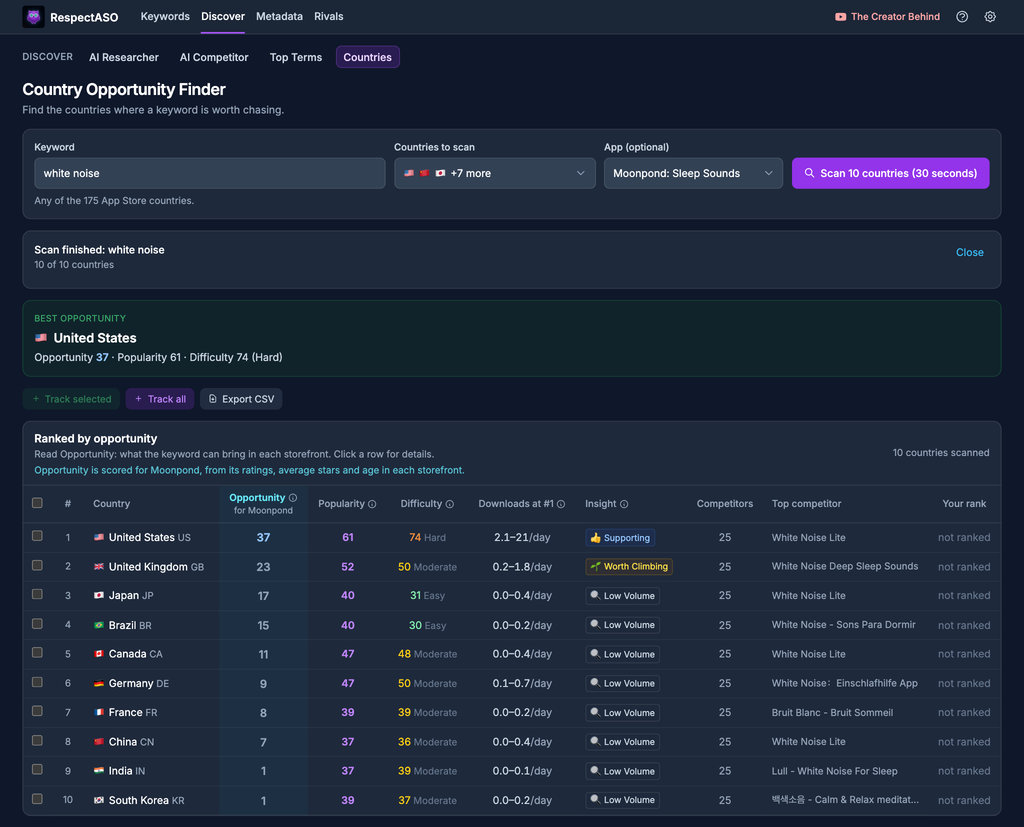
RespectASO's Country Opportunity Finder ranks the storefronts you pick for any keyword
Find the Best Keywords for Thailand
See which keywords your app can win in the Thailand App Store: RespectASO scores the popularity and difficulty of any keyword there, free on your Mac.