Saudi Arabia App Store
App Store Optimization for Saudi Arabia: The Complete ASO Guide
ASO guide for the Saudi App Store. Arabic keyword research with RTL considerations, high-spending market insights, and metadata optimization for Saudi users.
The Saudi Arabian App Store: The Gulf's Largest Premium Mobile Market
Saudi Arabia, with over 36 million people and one of the highest GDPs per capita in the Middle East, is the dominant App Store market in the Arab world. Saudi users are among the most active mobile consumers globally: the kingdom has one of the highest smartphone penetration rates and social media engagement rates in the world. For indie developers, Saudi Arabia represents a premium market with high per-user spending, a growing appetite for digital services, and relatively low App Store competition.
The Saudi Vision 2030 initiative is rapidly diversifying the economy beyond oil, driving massive digital transformation across entertainment, education, finance, and health. This creates expanding app demand in categories that were previously underserved in the kingdom.
User Behavior and Market Characteristics
Saudi users are enthusiastic app consumers with high spending power. The kingdom leads the Arab world in app downloads and revenue. Entertainment (gaming, streaming, social media), Shopping (e-commerce growth is explosive), Finance (digital banking and payments), Food & Drink (delivery apps), and Education are particularly strong categories.
Saudi Arabia has a young population (median age ~31) that is highly connected and mobile-first. Gaming is enormous: Saudi Arabia is one of the world's largest gaming markets by revenue per capita. Social media apps dominate usage time, with Saudi users among the most active globally on platforms like Snapchat, Twitter/X, and TikTok.
Seasonal Patterns
- Ramadan (dates vary): The most significant seasonal event. App usage patterns shift dramatically: late-night activity increases, food and recipe apps surge, religious and prayer apps peak, and entertainment consumption changes. Food & Drink and Lifestyle apps see major spikes during Ramadan.
- Eid al-Fitr and Eid al-Adha: Major holidays with gift-giving, travel, and shopping spikes. New device activations peak. Eid al-Fitr marks the end of Ramadan; Eid al-Adha is tied to the Hajj pilgrimage.
- Saudi National Day (September 23): A major national celebration with themed content, events, and promotional activity.
- Riyadh Season (October–March): Saudi Arabia's massive entertainment festival drives entertainment, events, and travel-related app downloads.
- Summer heat (June–August): Extreme temperatures drive indoor activity. Gaming, entertainment, and Education apps see increased engagement as people spend more time indoors.
Language and Localization
Saudi Arabia's primary App Store locale uses Arabic (ar-SA). Arabic is a right-to-left (RTL) script with unique characteristics that significantly impact ASO strategy.
Arabic Language Characteristics for ASO
- Right-to-left script: Arabic reads right to left, which means your metadata layout reverses. While Apple handles this in the App Store interface, mixed Arabic-English text can create display challenges. Test how your Title and Subtitle appear with RTL rendering.
- Root-based morphology: Arabic words are built from three-letter roots. "كتاب" (kitāb, book), "كاتب" (kātib, writer), "مكتبة" (maktaba, library) all share the root ك-ت-ب (k-t-b). Including different forms of the same root captures related searches.
- Definite article "ال" (al-): Arabic nouns take the prefix "ال" for definiteness. "حاسبة" (calculator) becomes "الحاسبة" (the calculator). Both forms may appear in searches. Include the base form without "ال" in keywords, because Apple's search algorithm handles article matching.
- Diacritical marks (tashkeel): Arabic text can include diacritical marks (harakat) that indicate vowels. In practice, most App Store searches omit diacritics. Optimize for the unvoweled forms that users actually type.
- English widely used: Saudi users, especially younger demographics, frequently search in English. English is taught from elementary school and widely used in professional and tech contexts. Include English keywords alongside Arabic in your keyword field.
Modern Standard Arabic vs. Saudi Dialect
Modern Standard Arabic (MSA/فصحى) is the formal written language, while Saudi Colloquial Arabic (عامية) is spoken daily. App Store metadata should generally use MSA for broad reach across all Arabic-speaking markets, but including Saudi-specific colloquial terms can capture local searches that MSA misses. For example, Saudi users might search "تطبيق" (tatbīq, application/app) in MSA or use colloquial phrasing.
Competition Landscape
Saudi Arabia's App Store has moderate domestic competition from local leaders (STC Pay, mada, Absher government services, Jarir for shopping) and strong representation from regional apps (Noon, Careem, Talabat). However, Arabic-language keyword competition from international developers is low: most global apps have English-only or poorly localized Arabic metadata.
Keyword difficulty for Arabic keywords in Saudi Arabia is typically 20–35 points lower than equivalent English keywords in the US. Arabic's script barrier creates a meaningful localization moat: developers who invest in proper Arabic metadata gain a significant advantage over English-only competitors.
Keyword Research Strategies for Saudi Arabia
1. Research Arabic Category Keywords
Identify the Arabic terms for your app's core functions. A finance app needs: "ميزانية" (budget), "مصاريف" (expenses), "ادخار" (savings), "حسابات" (accounts). These Arabic terms have real search volume in Saudi Arabia with much lower competition than English equivalents.
2. Include Both Arabic and English
Saudi users search in both languages. Your keyword field should include Arabic terms AND English equivalents: "فيتنس" (fitness in Arabic script) and "fitness," "تتبع" (tracking) and "tracker." This dual-language approach captures the full spectrum of Saudi search behavior.
3. Target Ramadan-Related Keywords
Ramadan creates massive, predictable keyword demand. "إمساكية" (Ramadan schedule), "أذان" (prayer call), "وصفات رمضان" (Ramadan recipes), "إفطار" (iftar/breaking fast). These seasonal keywords have enormous volume during the holy month. If your app has any Ramadan relevance, prepare optimized metadata before the month begins.
4. Compare Saudi Arabia with UAE
Use the Country Opportunity Finder to compare keywords across Saudi Arabia and the UAE. Both use Arabic but have different competitive dynamics and user preferences. Saudi Arabia has a larger population; the UAE has higher per-user spending. Understanding both markets helps prioritize your Arabic localization strategy.
Metadata Optimization for the Saudi Store
Title (30 Characters)
Arabic's right-to-left rendering means your title structure matters. Brand name (Latin) + Arabic descriptor works well: "BudgetPal: إدارة المصاريف" (brand + "expense management"). The mixed script is natural for Saudi users accustomed to seeing both.
Subtitle (30 Characters)
Focus on your primary Arabic keyword phrase: "تتبع المصاريف بسهولة" (approximately 19 characters; "Track expenses easily"). Arabic's connected script means character count can differ from visual word count.
Keyword Field (100 Characters)
Arabic characters in the keyword field count individually. Mix: Arabic category keywords (without "ال" prefix), English terms popular with Saudi users, Arabic transliterations of English concepts (فيتنس, تراكر), and Ramadan/seasonal keywords if relevant. Arabic text is character-efficient: many meaningful words are short (3–5 characters), leaving room for good breadth.
Common Mistakes
- Skipping Arabic entirely. Many international developers rely on Saudi English proficiency and skip Arabic localization. While English gets some traction, Arabic keywords face dramatically less competition and capture the majority of Saudi search traffic.
- Using dictionary Arabic without local relevance. Formal MSA is correct for metadata, but missing Saudi-specific terms (government services, local payment methods, cultural events) means missing locally relevant keyword opportunities.
- Ignoring Ramadan optimization. Ramadan is the single largest app behavior shift in Saudi Arabia. Not preparing Ramadan-optimized metadata (for relevant apps) is like ignoring Christmas in Western markets, and potentially even more impactful.
- Not testing RTL rendering. Mixed Arabic-English metadata can display unexpectedly in the App Store. Test how your title and subtitle render in the actual store listing before publishing.
- Assuming low willingness to pay. Saudi iPhone users have high purchasing power. The market is premium: users will pay for quality apps that are well-localized and culturally appropriate.
How RespectASO Helps in the Saudi Market
RespectASO supports Saudi Arabia as one of its 175 storefronts. Score Arabic and English keywords on popularity (1–100), difficulty (1–100), and opportunity (0–100). The scoring quantifies the advantage that Arabic localization provides over English-only metadata in the Saudi store.
Search a whole list of keywords at once to evaluate Arabic terms, English equivalents, and seasonal variations. The Country Opportunity Finder lets you compare Saudi Arabia against the UAE and all other markets, revealing where Arabic keywords offer the best combination of demand and low competition.
For the Gulf's largest and most valuable mobile market, RespectASO provides the quantitative data to make informed Arabic keyword investments, turning a market that many developers overlook into a strategic revenue opportunity.
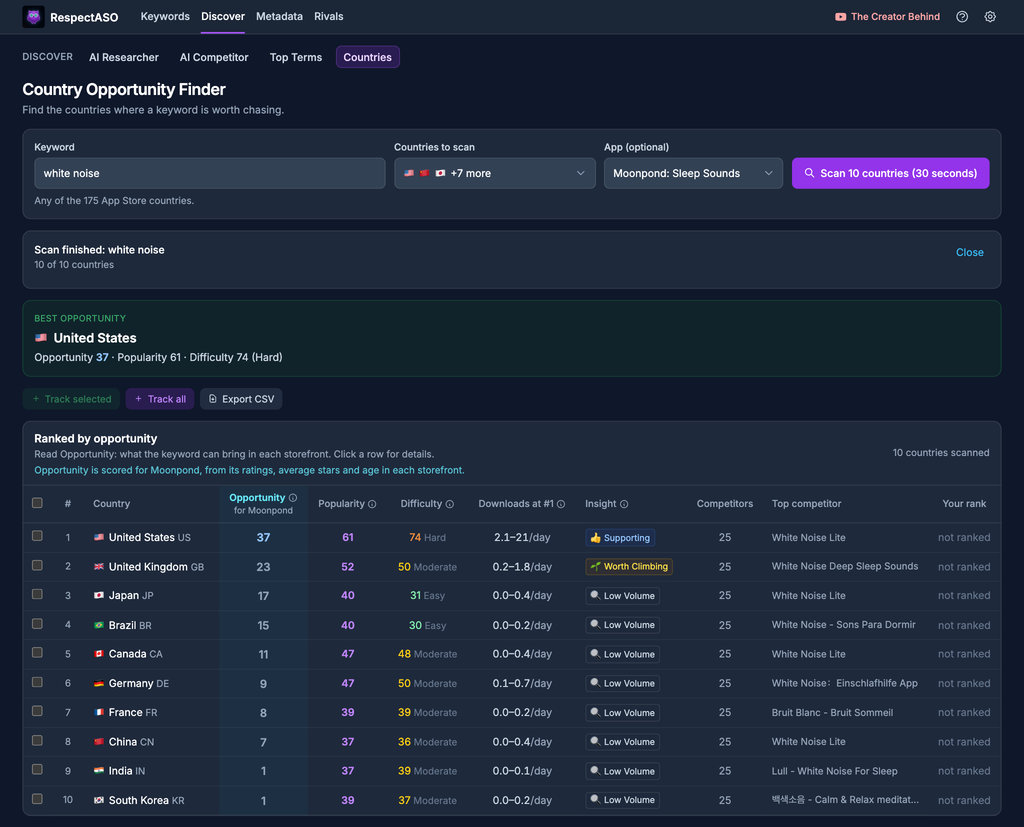
RespectASO's Country Opportunity Finder ranks the storefronts you pick for any keyword
Find the Best Keywords for Saudi Arabia
See which keywords your app can win in the Saudi Arabia App Store: RespectASO scores the popularity and difficulty of any keyword there, free on your Mac.