Turkey App Store
App Store Optimization for Turkey: The Complete ASO Guide
ASO guide for the Turkish App Store. Turkish keyword research with agglutinative language strategies, fast-growing market insights, and metadata optimization.
The Turkish App Store: A Young, Growing Market at the Crossroads
Turkey, with over 85 million people, is one of the largest and youngest markets in RespectASO's coverage. Straddling Europe and Asia, Turkey has a rapidly growing smartphone market with a youthful, tech-engaged population. The Turkish App Store represents a significant opportunity for indie developers: a large user base, a unique language that creates a strong localization moat, and keyword difficulty levels dramatically lower than in Western markets.
Turkey's young demographics (median age ~32) translate into a highly engaged mobile user base. Social media, gaming, Entertainment, and Finance apps are particularly popular. For developers who invest in Turkish localization, the reward is access to a market where most international competitors have zero Turkish metadata.
User Behavior and Market Characteristics
Turkish users are highly active on mobile, spending significant time on social media, messaging, and entertainment apps. Turkey has some of the highest social media usage rates in the world. The Turkish market is price-sensitive (users strongly prefer free or affordable apps), but engagement is high and installs are plentiful.
E-commerce and fintech are booming in Turkey. Apps like Trendyol (shopping), Papara and Tosla (digital banking for youth), and Getir (rapid delivery) have become daily-use applications. Shopping, Finance, Education, and Food & Drink are particularly strong categories.
Seasonal Patterns
- Ramadan and Eid (dates vary): The Islamic calendar creates major seasonal shifts. Ramadan drives demand for fasting, prayer, and recipe apps. Eid al-Fitr (Ramazan Bayramı) and Eid al-Adha (Kurban Bayramı) are major holidays with family travel and shopping.
- Summer holidays (June–September): Turkey's long summer drives Travel, Navigation, and Photo & Video app demand. Domestic tourism is enormous.
- School season (September): Turkey's school year starts in September. Education apps, particularly exam preparation apps, see major spikes.
- Republic Day (October 29): National holiday with seasonal engagement patterns.
- Black Friday / Efsane Cuma (November): Adopted enthusiastically in Turkey as "Legendary Friday." Shopping and deal-finding apps surge.
Language and Localization
Turkish (tr-TR) is a Turkic language with agglutinative morphology, structurally similar to Finnish and Japanese in its word-building approach. Turkish creates long words by stacking suffixes, which has direct implications for ASO strategy.
Turkish Language Characteristics for ASO
- Agglutination: Turkish builds words by adding suffixes: "ev" (house) → "evler" (houses) → "evlerimizde" (in our houses). For ASO, this means a single base word can generate many searchable variants. Include the base form and the most common suffixed forms.
- Vowel harmony: Turkish suffixes change based on vowel harmonization rules. "Kalori sayacı" (calorie counter) follows different vowel patterns than "bütçe yönetici" (budget manager). This is grammatically important but doesn't significantly affect keyword selection, so focus on base forms.
- Special characters: Turkish has distinctive characters: ç, ğ, ı (dotless i), İ (dotted capital I), ö, ş, ü. The dotless ı / dotted I distinction is unique to Turkish and critical: "sığır" (cattle) vs. "sigir" would be wrong. Apple's search partially handles substitutions, but correct Turkish characters are important for readability.
- No grammatical gender: Turkish has no gendered nouns or articles. This simplifies keyword selection: no masculine/feminine variants to worry about.
- English loanwords: Turkish absorbs many English words, sometimes with Turkish spelling: "bilgisayar" (computer, from Turkish roots), but also "online," "internet," "app," "fitness" used directly.
Competition Landscape
Turkey's App Store has moderate competition from domestic players in key verticals but low competition from international developers. Strong Turkish apps include Trendyol (shopping), Hepsiburada (e-commerce), Getir (delivery), BiP (messaging), and various banking apps. However, outside these vertical leaders, Turkish-language keyword competition is remarkably low.
Keyword difficulty in Turkey is typically 25–40 points lower than in the US. Turkish-language keywords see particularly low competition because Turkish is spoken primarily in one country (unlike Arabic, Spanish, or Portuguese), and few international developers invest in Turkish localization. This creates abundant Sweet Spot and Hidden Gem opportunities.
Keyword Research Strategies for Turkey
1. Focus on Turkish Base Words
Start with the base (unsuffixed) forms of your target keywords: "bütçe" (budget), "sağlık" (health), "egzersiz" (exercise), "tarif" (recipe), "haber" (news). Turkish users search with both base and suffixed forms, but the base form is the most universally matching keyword to include.
2. Include Both Turkish and English Terms
Young Turkish users frequently search English terms, especially in tech and fitness categories. Include both "antrenman" (workout) and "workout," both "hesap makinesi" (calculator) and "calculator." Use RespectASO to compare popularity of each variant.
3. Target Education and Exam Keywords
Turkey has a highly competitive exam culture. Keywords around "sınav" (exam), "ders" (lesson), "çalışma" (study), "TYT" and "AYT" (university entrance exam categories), and "KPSS" (civil service exam) have enormous search volume with relatively achievable difficulty. If your app has any educational application, Turkish exam keywords are high-value targets.
4. Compare Turkey with Middle Eastern Markets
Use the Country Opportunity Finder to compare keywords across Turkey, Saudi Arabia, and UAE. While the languages are different, some cultural and seasonal patterns (Ramadan, Eid) overlap. Understanding Turkey's position relative to Arabic-speaking markets helps prioritize your localization investments.
Metadata Optimization for the Turkish Store
Title (30 Characters)
Turkish agglutination can create long words. Be concise: "BütçeLog: Harcama takibi" (25 characters; "BütçeLog: Expense tracking"). Use short, high-impact Turkish keywords to maximize information per character.
Subtitle (30 Characters)
Focus on a strong Turkish keyword phrase: "Para tasarrufu ve bütçe" (23 characters; "Money savings & budget"). Natural Turkish phrasing with two high-value keywords.
Keyword Field (100 Characters)
Mix: base Turkish keywords ("bütçe," "harcama," "tasarruf"), English loanwords ("fitness," "tracker," "budget"), Turkish verb stems ("harcamak" = to spend, "biriktirmek" = to save up), and Turkey-specific terms (government services, exam names). Don't include the title/subtitle keywords again, because Apple indexes those separately.
Common Mistakes
- Ignoring the dotless ı. The Turkish ı (dotless) and i (dotted) are different letters. Getting these wrong creates spelling errors that are jarring to Turkish users. "Işık" (light) vs. "isik" is the kind of error that signals a careless localization.
- Skipping Ramadan optimization. Ramadan creates massive demand shifts in Turkey. Apps that don't prepare for this seasonal pattern (which moves through the calendar year) miss major engagement windows.
- Underestimating Turkey's market size. With 85+ million people and a young, mobile-first population, Turkey is larger than any individual European country in the App Store. Low per-user revenue is partially offset by sheer download volume.
- Machine-translating Turkish. Turkish's agglutinative structure makes it particularly prone to translation errors. Incorrect suffix combinations produce words that don't exist. Native Turkish review of metadata is strongly recommended.
- Forgetting about exam season. Turkey's exam culture drives massive seasonal keyword demand. Not targeting exam-related keywords (for education-adjacent apps) leaves high-volume opportunities untouched.
How RespectASO Helps in the Turkish Market
RespectASO supports Turkey as one of its 175 storefronts. Score Turkish and English keywords on popularity (1–100), difficulty (1–100), and opportunity (0–100). The data quantifies Turkey's low competition and helps identify which Turkish keywords offer the best return.
Search a whole list of keywords at once to compare Turkish base words, suffixed variants, and English equivalents. The Country Opportunity Finder reveals how Turkish keyword difficulty compares to other markets of similar size, highlighting Turkey's unique position as one of the largest underserved markets in RespectASO's coverage.
For a market where 85 million potential users meet minimal keyword competition, RespectASO provides the data foundation to make strategic Turkish localization decisions that maximize your App Store visibility in this young, growing market.
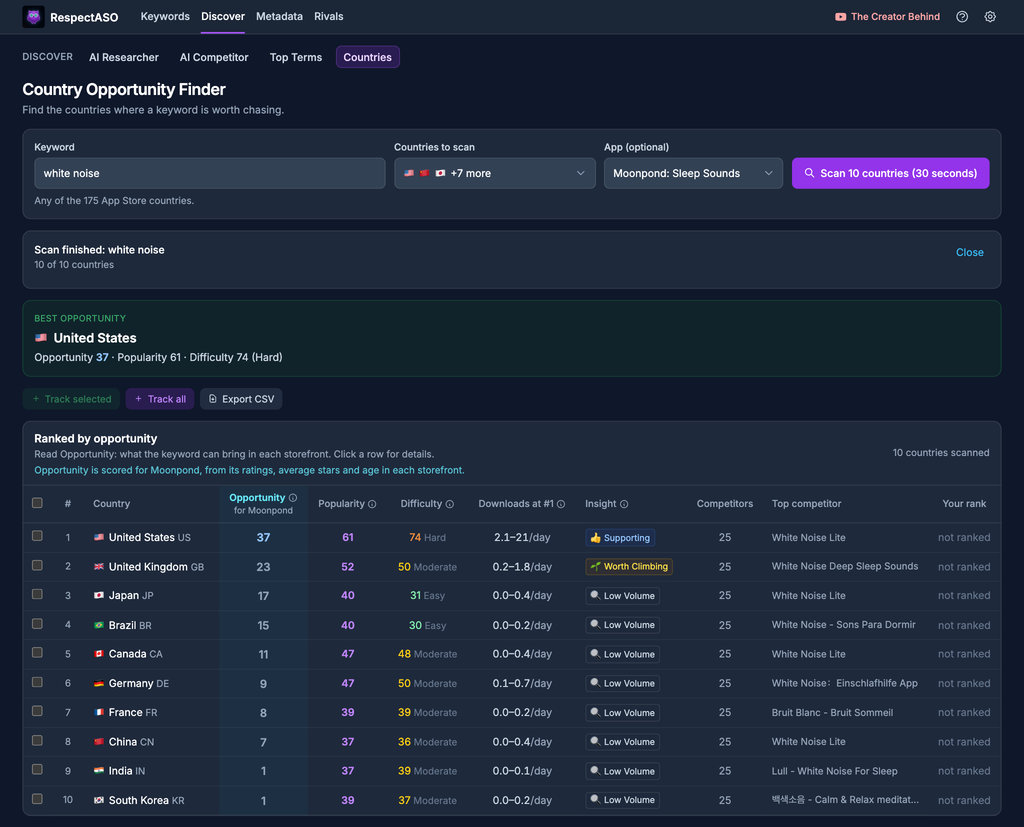
RespectASO's Country Opportunity Finder ranks the storefronts you pick for any keyword
Find the Best Keywords for Turkey
See which keywords your app can win in the Turkey App Store: RespectASO scores the popularity and difficulty of any keyword there, free on your Mac.