Category Guide
App Store Optimization for Travel Apps: Strategy Guide
ASO strategy guide for travel apps on iOS. Keyword targeting for booking, navigation, and travel planning apps with seasonal and regional insights.
The Travel Category Landscape
Travel apps encompass booking (flights, hotels, vacation rentals), navigation (maps, transit, offline guides), trip planning (itineraries, packing lists), and travel tools (currency converters, translation, Wi-Fi finders). The category is dominated by massive booking platforms, but the planning, navigation, and utility segments offer meaningful space for independent developers.
Travel search behavior is highly seasonal and intent-driven: users searching to book need one type of app, users planning need another, and users already traveling need yet another. Understanding which travel phase you serve is essential for effective keyword targeting.
Keyword Patterns in Travel
Travel Phase Keywords
Each phase of a trip has its own searches:
- Booking: "flights," "hotel," "car rental," "vacation," "cheap flights," "hotel deals"
- Planning: "trip planner," "travel planner," "itinerary," "packing list"
- Navigation: "offline maps," "city guide"
- Travel tools: "currency converter," "translator"
- Niche travel: "road trip," "camping," "backpacking," "cruise"
Booking searches lead to the big platforms; planning, navigation, tools and niche travel are where an independent app competes. The table below measures every phase.
24 travel keywords, measured in the US App Store
Measured by RespectASO on 6 October 2026. Popularity is RespectASO's estimate of how often a keyword is searched compared with others, from 1 to 100. Difficulty, from 1 to 100, says how hard the apps already on top are to pass. "In top 10 names" counts the top ten apps with the keyword in their name. How the numbers work.
| Keyword | Popularity | Difficulty | In top 10 names |
|---|---|---|---|
| Head terms | |||
| flights | 78 | 88 Very Hard | 5 of 10 |
| hotel | 76 | 92 Extreme | 10 of 10 |
| travel planner | 63 | 69 Hard | 5 of 10 |
| trip planner | 58 | 67 Hard | 3 of 10 |
| car rental | 66 | 81 Very Hard | 7 of 10 |
| vacation | 74 | 86 Very Hard | 3 of 10 |
| Features and sub-genres | |||
| itinerary | 43 | 43 Moderate | 2 of 10 |
| packing list | 41 | 41 Moderate | 8 of 10 |
| offline maps | 52 | 53 Moderate | 4 of 10 |
| currency converter | 58 | 69 Hard | 6 of 10 |
| translator | 64 | 76 Very Hard | 7 of 10 |
| city guide | 40 | 33 Easy | 4 of 10 |
| Audiences and uses | |||
| road trip | 57 | 63 Hard | 7 of 10 |
| camping | 63 | 75 Hard | 7 of 10 |
| backpacking | 49 | 46 Moderate | 3 of 10 |
| cruise | 61 | 72 Hard | 7 of 10 |
| cheap flights | 65 | 82 Very Hard | 2 of 10 |
| hotel deals | 56 | 74 Hard | 1 of 10 |
| Long-tail phrases | |||
| offline maps and city guide | 22 | 19 Easy | 0 of 10 |
| road trip planner app | 31 | 43 Moderate | 0 of 10 |
| paris offline map | 33 | 25 Easy | 7 of 10 |
| thailand travel guide | 31 | 21 Easy | 6 of 10 |
| offline translator for travel | 33 | 34 Easy | 0 of 10 |
| travel packing list | 37 | 37 Moderate | 6 of 10 |
Difficulty here runs from 19 for "offline maps and city guide" to 92 for "hotel". 9 of the 24 keywords score 70 or more, and 3 score under 30. The long-tail phrases have a median difficulty of 29, against 83 for the head terms. The highest popularity among keywords under difficulty 50 belongs to "backpacking": 49, at difficulty 46.
To see what these keywords would bring your own app, and to measure them in any of the 175 storefronts, run them in RespectASO, free on your Mac.
Destination-Specific Keywords
Destination names create natural keyword modifiers: "paris offline map," "thailand travel guide." Someone typing one knows exactly where they are going. Your keyword field can include destination names that pair with your title's function word to capture these queries.
Seasonal Travel Patterns
Travel searches follow the calendar: spring for summer trips, late autumn for winter holidays, and the weeks before major holidays. These predictable cycles make seasonal metadata updates (rotating destination and activity keywords) worth the effort.
Metadata Optimization for Travel Apps
Lead with Function, Not Destination
Your title should communicate what your app does, not where it works: "Offline Maps & City Guide" says more than "TravelMate" because users search for functions. The subtitle adds scope: "Navigate 200+ Cities Without Wi-Fi." Destinations go in the keyword field where the search algorithm combines them with your title terms.
Offline Capability Keywords
"Offline" is a modifier travelers type on purpose, because they want apps that work without a connection: "offline maps," "offline translator for travel," "offline maps and city guide." If your app works offline, say so prominently: it is a keyword and a reason to download for travelers who worry about data costs abroad.
Common ASO Mistakes in Travel
- Competing with booking giants: Unless you're a booking platform, check "cheap flights" and "hotel deals" in the table before you target them. Travel planning, navigation and utility keywords are where a non-booking app belongs.
- Ignoring language/locale: Travel apps need localization more than most categories. A guide app localized in Japanese can match the searches people in Japan actually type, which an English-only equivalent cannot, even if the destinations are the same.
- Static metadata year-round: Travel is inherently seasonal. Not updating keywords and screenshots for peak travel seasons means missing the moments people search most.
- Too many features, unclear positioning: "Trip Planner + Hotel Deals + Offline Maps + Currency Converter + Translator" confuses the search algorithm and users alike. Pick your core function and optimize for it.
Competitor Landscape
Booking apps (Booking.com, Airbnb, Expedia) and map apps (Google Maps, Apple Maps) dominate broad travel keywords. Trip planners, packing list apps, travel journals, niche destination guides, and travel tools are a different market. Competitor analysis shows how many well-optimized apps a niche really has, and where thoughtful metadata leaves room to rank.
International Opportunity
Travel is intrinsically global: users in every market search for travel apps, and the same keyword can be crowded in one storefront and open in another. Compare "travel planner" in the US (measured above) with its equivalents in South Korea, Turkey, or Brazil: the Country Opportunity Finder ranks those storefronts by opportunity for your app.
How RespectASO Helps
Travel apps often struggle with keyword selection because the category spans such diverse functions: booking, navigation, planning, utilities. Use Multi-Keyword Search to score function keywords, destination keywords, and modifier keywords together. Compare popularity and difficulty across markets to find where your specific travel function has the best match between search demand and competitive opportunity.
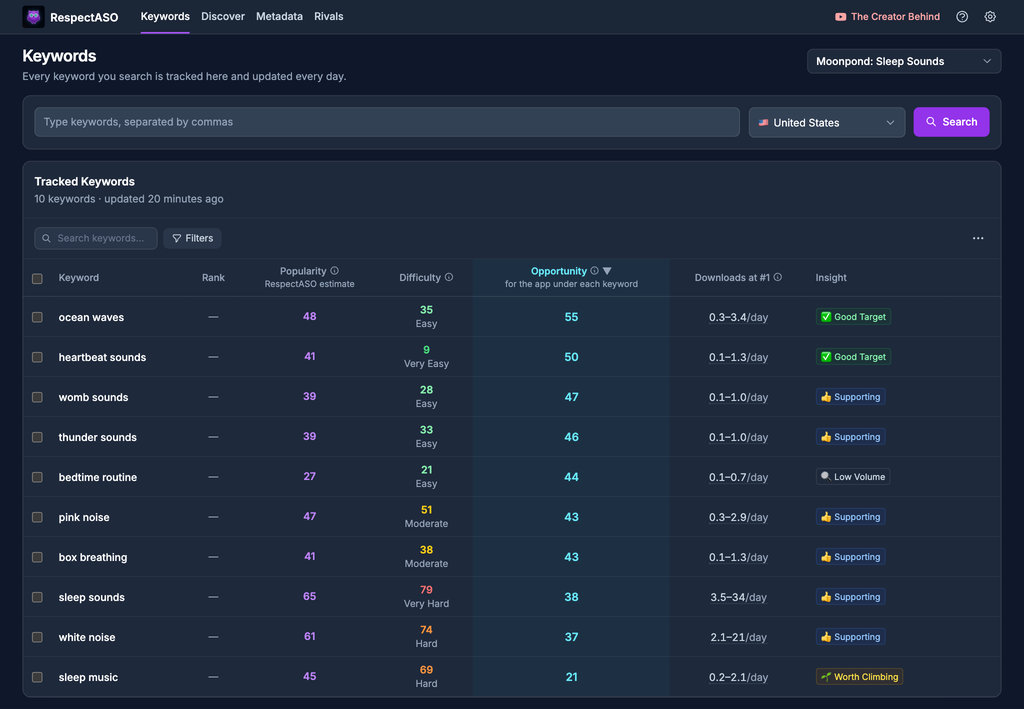
Keyword research in RespectASO: a score and a tag for every keyword
Optimize Your Travel App
Use RespectASO to research keywords and build a data-driven ASO strategy for Travel apps.