Italy App Store
App Store Optimization for Italy: The Complete ASO Guide
ASO guide for the Italian App Store. Italian keyword research, competition landscape, and metadata localization strategies for Italian users.
The Italian App Store: Premium Market with Mediterranean Character
Italy, the third-largest economy in the Eurozone, represents a sophisticated App Store market with strong purchasing power and distinctive cultural characteristics. With over 60 million people and a deep appreciation for design and quality, Italian iPhone users expect polished, well-localized apps. Italy's App Store tends to reward developers who invest in genuine Italian localization: not just translated metadata, but a culturally attuned approach.
For indie developers, Italy offers a compelling middle ground: a large enough market to generate meaningful downloads and revenue, but with less ferocious competition than the English-speaking giants. The language barrier serves as a natural moat: developers who localize properly gain an outsized advantage.
User Behavior and Market Characteristics
Italian smartphone users are highly mobile-dependent, with one of the highest rates of mobile internet usage in Europe. Social media, messaging, and Food & Drink apps are particularly popular, reflecting Italy's social and culinary culture. The Italian market also shows strong demand in Finance (particularly mobile banking and investment tracking), Health & Fitness, and Travel.
Italian users are design-conscious. An app that looks polished, with clean typography and thoughtful Italian UI text, will convert better than a functionally identical app with rough translation. This cultural expectation for aesthetics and attention to detail is both a challenge and an opportunity.
Seasonal Patterns
- Ferragosto and summer (August): August is Italy's primary vacation month, with Ferragosto (August 15) as the peak. Travel, Navigation, and Photo & Video apps surge.
- Rientro (September): Italy's "return" from summer. Education, Productivity, and organizational apps see their biggest spike.
- Natale and Epifania (December–January 6): Christmas through Epiphany is a major gifting season. Like Spain, Italy extends its holiday season to January 6 (La Befana).
- Serie A season (August–May): Italian football drives Sports app engagement throughout the season.
- Tax season (June–July): The "dichiarazione dei redditi" period drives Finance and tax-related app downloads.
Language and Localization
Italian (it-IT) is a Romance language with rich morphology that creates unique ASO opportunities. Italian text is typically 15–20% longer than equivalent English, which makes the tight character limits of App Store metadata a meaningful challenge.
Italian Language Characteristics for ASO
- Articles are essential: Italian nouns rarely appear without articles ("il," "lo," "la," "i," "gli," "le"). In metadata, dropping articles saves characters, but search behavior includes them. "Contatore calorie" (without article) matches searches for "il contatore di calorie."
- Verb infinitives are searchable: Italians often search with infinitive verbs: "contare calorie" (to count calories), "risparmiare" (to save), "organizzare" (to organize). These verb forms are strong keyword candidates.
- Diminutives and augmentatives: Italian uses suffixes to modify words: "appuntino" (a small appointment/note), "libraccio" (a bad book). These colloquial forms sometimes appear in searches.
- English tech loanwords: Italian absorbs English terms in technology: "smartphone," "tablet," "fitness," "tracker," "budget," "app." These are valid search terms in the Italian App Store and should appear in your keyword field alongside Italian equivalents.
Character Efficiency Challenge
Italian's longer word length compared to English makes the 30-character title and subtitle limits more restrictive. "Expense tracker" is 15 characters in English; "tracciatore spese" is 17 in Italian. Every character saved matters. Use abbreviations common in Italian (e.g., "app" instead of "applicazione"), drop articles, and favor shorter synonym variants. Like Germany, character efficiency is a genuine strategic consideration, not just a formatting detail.
Competition Landscape
Italy's App Store features strong local players in key verticals (Satispay for payments, il Post and Corriere for news) alongside global apps. However, many international apps either skip Italian localization entirely or use poor machine-translated metadata. This creates a clear gap between the few properly localized competitors and the majority with subpar Italian presence.
Difficulty scores in Italy are typically 20–30 points lower than in the US. Italian-language keywords are especially favorable because the language barrier eliminates the most casual competitors. Compound Italian phrases of three or more words frequently show very low difficulty, creating numerous Sweet Spot opportunities.
Keyword Research Strategies for Italy
1. Research Natural Italian Search Phrasing
Italian users search differently from English speakers. A budget app would target "gestione spese" (expense management), "risparmiare soldi" (save money), "bilancio personale" (personal budget). Direct English-to-Italian translation often produces correct but unnatural phrases that real users don't search. Researching native Italian phrasing turns up better keyword opportunities.
2. Include Both English and Italian Equivalents
Italian users frequently mix English terms into searches, especially for tech and fitness categories. Include both: "workout" and "allenamento," "tracker" and "monitoraggio," "budget" and "bilancio." RespectASO lets you compare popularity of each to allocate your limited characters wisely.
3. Target Verb-Based Keywords
Italian users often search using infinitive verbs: "gestire" (to manage), "monitorare" (to monitor), "calcolare" (to calculate), "organizzare" (to organize). These verb forms have consistent search volume and lower competition than noun-based equivalents. Including verb-form keywords is a distinctly Italian ASO strategy.
4. Exploit the France-Italy Overlap
Italian and French are sister Romance languages with some vocabulary overlap (especially in technical and culinary contexts). Use the Country Opportunity Finder to compare French and Italian opportunity scores for similar keywords, because insights from one market often translate to the other.
Metadata Optimization for the Italian Store
Title (30 Characters)
Italian's longer words demand ruthless efficiency. Lead with your brand name and a single Italian keyword: "SpesaLog: Gestione spese" (24 characters). Drop articles entirely in titles. Prefer shorter Italian synonyms ("spese" at 6 chars over "spese personali" at 15 chars) and let the subtitle carry additional keywords.
Subtitle (30 Characters)
Focus on your primary Italian keyword phrase. "Bilancio e risparmio facile" (27 characters, "easy budget & savings") uses natural Italian phrasing with two high-value keywords. The subtitle should read naturally to Italian users: forced keyword stuffing is more obvious in Italian than in English.
Keyword Field (100 Characters)
Combine Italian keywords, English loanwords, verb infinitives, and singular/plural variants. Italian pluralization changes word endings (spesa→spese, conto→conti), and each form may match different searches. Include the verb forms that Italian users naturally search with. Don't waste characters on articles or prepositions; Apple's algorithm handles those.
Common Mistakes
- Machine-translating metadata. Italian speakers instantly recognize robot translations. "Inseguitore di spese" (literal translation of "expense tracker") is nonsensical Italian. The natural term is "gestione spese" or "monitoraggio spese." Bad translation damages conversion and trust.
- Ignoring the August pause. Not preparing for Ferragosto means missing Italy's biggest seasonal shift. Users download travel and entertainment apps before August and organizational apps when they return in September.
- Treating Italy like Spain. Although both are Romance languages, Italian and Spanish keyword strategies differ significantly. Italian has different vocabulary, different grammar patterns, and different cultural associations.
- Neglecting verb forms. Missing Italian infinitive keywords ("risparmiare," "contare," "gestire") means missing a major search pattern unique to Italian (and other Romance language) users.
- Overlooking design expectations. Italian users notice and care about visual quality. Poorly formatted App Store screenshots or sloppy Italian text in screenshots will hurt conversion rates more in Italy than in many other markets.
How RespectASO Helps in the Italian Market
RespectASO supports Italy as one of its 175 storefronts with full keyword scoring. Score Italian keywords on popularity (1–100), difficulty (1–100), and opportunity (0–100) to find the Italian keywords that offer the best return on your limited metadata space.
Multi-keyword search (a whole list at once, up to 1,000 keywords per search with Pro) lets you evaluate Italian words, English variants, verb forms, and noun forms simultaneously. The Country Opportunity Finder reveals how Italian keyword difficulty compares to other European markets like France, Germany, and Spain.
For a market where quality localization directly translates into ranking advantage, RespectASO provides the data to invest your Italian metadata characters where they'll have the greatest impact.
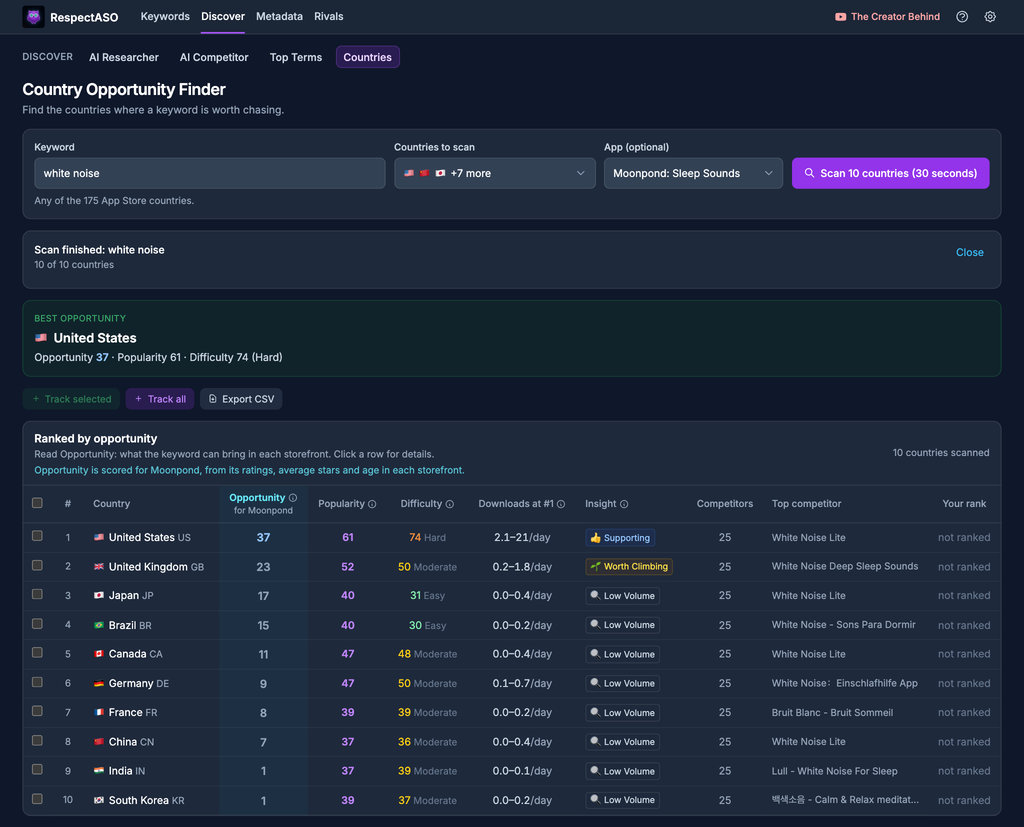
RespectASO's Country Opportunity Finder ranks the storefronts you pick for any keyword
Find the Best Keywords for Italy
See which keywords your app can win in the Italy App Store: RespectASO scores the popularity and difficulty of any keyword there, free on your Mac.