Spain App Store
App Store Optimization for Spain: The Complete ASO Guide
ASO guide for the Spanish App Store. Spanish keyword research, differences from Latin American Spanish, and metadata optimization for the Spanish market.
The Spanish App Store: Gateway to the Hispanic World
Spain is the fourth-largest economy in the Eurozone and a strategically important App Store market. With over 47 million people and one of the highest smartphone penetration rates in Europe, Spain offers indie developers a sizable, engaged audience. But Spain's real strategic value extends beyond its borders: it's the gateway to the broader Spanish-speaking world of over 500 million people.
Spanish App Store optimization done properly in Spain creates a foundation for Mexico and the rest of Latin America. While Latin American Spanish differs from Castilian, the core keyword overlap is significant. Developers who master Spain first gain a playbook for the wider Hispanic market.
User Behavior and Market Characteristics
Spanish iPhone users are enthusiastic app consumers, particularly in Lifestyle, Food & Drink, Travel, and Entertainment categories. Spain has a strong social culture, which translates into high download rates for social, messaging, and entertainment apps. The Spanish user base is price-conscious but willing to pay for quality: one-time purchases and annual subscriptions perform better than expensive monthly plans.
Seasonal Patterns
- La vuelta al cole (September): Spain's "back to school" period. Education, Productivity, and organizational apps see strong demand.
- Christmas / Reyes Magos (December–January 6): Unlike most Western countries where Christmas is the peak, Spain has a second gifting peak on January 6 (Three Kings Day). New device activations extend well into January.
- Summer holidays (July–August): Travel, Navigation, Photo & Video, and entertainment apps spike. Spain's summer break is among Europe's longest.
- Semana Santa (Easter week, March/April): A major travel period within Spain, boosting navigation, travel, and local discovery apps.
- La Liga season (August–May): Sports app engagement follows the football calendar.
Language and Localization
Spain's App Store locale is es-ES (European Spanish / Castilian). Spanish localization is rich territory for ASO because of how different Spanish is from English: the language opens an entirely separate keyword universe.
Castilian Spanish Specifics
Spain uses distinctive vocabulary and grammar compared to Latin American Spanish:
- "ordenador" vs. "computadora": Spain says "ordenador" for computer, while Latin America uses "computadora" or "computador."
- "móvil" vs. "celular": "Móvil" is the standard term for mobile phone in Spain. Latin America uses "celular."
- "coche" vs. "carro": Spain uses "coche" for car, while most of Latin America uses "carro" or "auto."
- Vosotros form: Spain's informal plural "you" (vosotros) is unique to Castilian. It affects verb conjugations but doesn't impact most ASO keyword targeting.
- "aplicación" or "app": Spanish users commonly search both the English "app" and the Spanish "aplicación." Covering both captures wider traffic.
Accent Characters
Spanish requires accent marks (tildes): á, é, í, ó, ú, ñ, ü. Apple's search algorithm generally matches accented and non-accented variants, but including the correct accented form signals quality metadata that resonates with native speakers. "Organización" reads better than "organizacion" to a Spanish user, even if search matching is equivalent.
Regional Languages
Spain also has Catalan, Basque (Euskara), and Galician, each with millions of speakers. Apple supports Catalan in the App Store. For apps with regional relevance (Barcelona, Basque Country), including some Catalan keywords can capture a passionate, underserved audience, since very few international apps bother with Catalan optimization.
Competition Landscape
Spain's App Store competition is moderate compared to the United States and United Kingdom. Major international apps are present, but many haven't deeply localized their Spanish metadata. Local Spanish apps tend to optimize well in obvious categories (banking, food delivery, transport) but leave plenty of gaps in more niche categories.
Keyword difficulty in Spain typically runs 15–25 points lower than equivalent US keywords. This meaningful gap exists because fewer developers compete specifically for the es-ES locale. Compound Spanish keywords and phrases (three or more words) frequently show very low difficulty with respectable popularity; these are prime Sweet Spot targets.
Keyword Research Strategies for Spain
1. Think in Spanish, Not Translated English
Direct translation from English misses how Spanish users actually search. A Health & Fitness app might translate "calorie counter" to "contador de calorías," but Spanish users often search "contar calorías" (verb form) or simply "dieta." Native keyword thinking (what would a Spanish person type?) yields better results than mechanical translation.
2. Leverage Gender Variants
Spanish nouns have gender, and many keywords have masculine/feminine forms. "Entrenador" (male trainer) and "entrenadora" (female trainer) are different search terms with different competition. The gendered variant that fewer competitors target is often an easy Hidden Gem.
3. Include Both English and Spanish Terms
Spanish users mix English tech terms into searches. "Fitness," "tracker," "app," "podcast," and "workout" are commonly searched in English, even in Spain. Your keyword field should include both the Spanish term and the English equivalent where applicable. Use RespectASO to compare popularity of each variant to prioritize.
4. Compare Spain vs. Mexico Opportunity
Use the Country Opportunity Finder to compare the same Spanish keyword in Spain (es-ES) and Mexico (es-MX). You'll often find that keywords competitive in Spain have excellent opportunity scores in Mexico, and vice versa. The vocabulary differences between the two markets create natural arbitrage opportunities.
Metadata Optimization for the Spanish Store
Title (30 Characters)
Spanish is about 15–25% longer than equivalent English text. This makes the 30-character title limit tighter. Be concise: "GastoLog: Control de gastos" (27 characters) names the app and its function. Avoid articles ("el," "la," "los," "las") in titles: they consume characters without adding search value.
Subtitle (30 Characters)
Use your most important Spanish keyword phrase. "Presupuesto y ahorro fácil" (27 characters; "easy budget & savings") packs two high-value keywords into the subtitle. Remember that subtitle keywords carry significant weight in search ranking.
Keyword Field (100 Characters)
Mix Spanish keywords with English loanwords. Include singular and plural forms (Spanish pluralization affects search matching differently than English). Add regional vocabulary variants if you want to cross-capture users from the Mexican locale. Consider verb infinitives: Spanish users often search with verbs ("ahorrar," "rastrear," "organizar").
Common Mistakes
- Using Latin American Spanish for Spain. Mexican or generic "International Spanish" metadata uses vocabulary that feels wrong to Peninsular Spanish speakers. "Celular" instead of "móvil" signals a developer who doesn't understand the market.
- Ignoring the Reyes Magos peak. Many developers treat Christmas as the only December holiday peak and miss January 6, when millions of Spanish children receive gifts (and new devices).
- Omitting English loanwords. Tech-savvy Spanish users search English terms regularly. Not including "fitness," "tracker," or "app" in your Spanish keyword field leaves easy traffic uncaptured.
- Translating word-for-word. Natural Spanish phrasing differs from English structure. "Weather forecast app" shouldn't be mechanically translated: "predicción del tiempo" or "el tiempo" is how Spanish users search for weather.
- Forgetting Catalan. If you target Barcelona or Catalonia specifically, Catalan keywords face almost no competition and connect deeply with a loyal user base.
How RespectASO Helps in the Spanish Market
RespectASO supports Spain as one of its 175 storefronts with full keyword scoring. Evaluate Spanish keywords with popularity (1–100), difficulty (1–100), and opportunity (0–100) scores. This lets you quantify the advantage that Spanish localization provides over English-only metadata.
Search a whole list of keywords at once to quickly evaluate Spanish terms, English loanwords, and their respective competition levels. The Country Opportunity Finder is particularly powerful for Spain because it lets you assess the same keyword across multiple Spanish-speaking markets (Spain, Mexico, and beyond), revealing where each term performs best.
For a market where proper Spanish localization provides a 15–25 point difficulty advantage over generic English, RespectASO gives you the data to prioritize the most impactful keywords in your limited character budget.
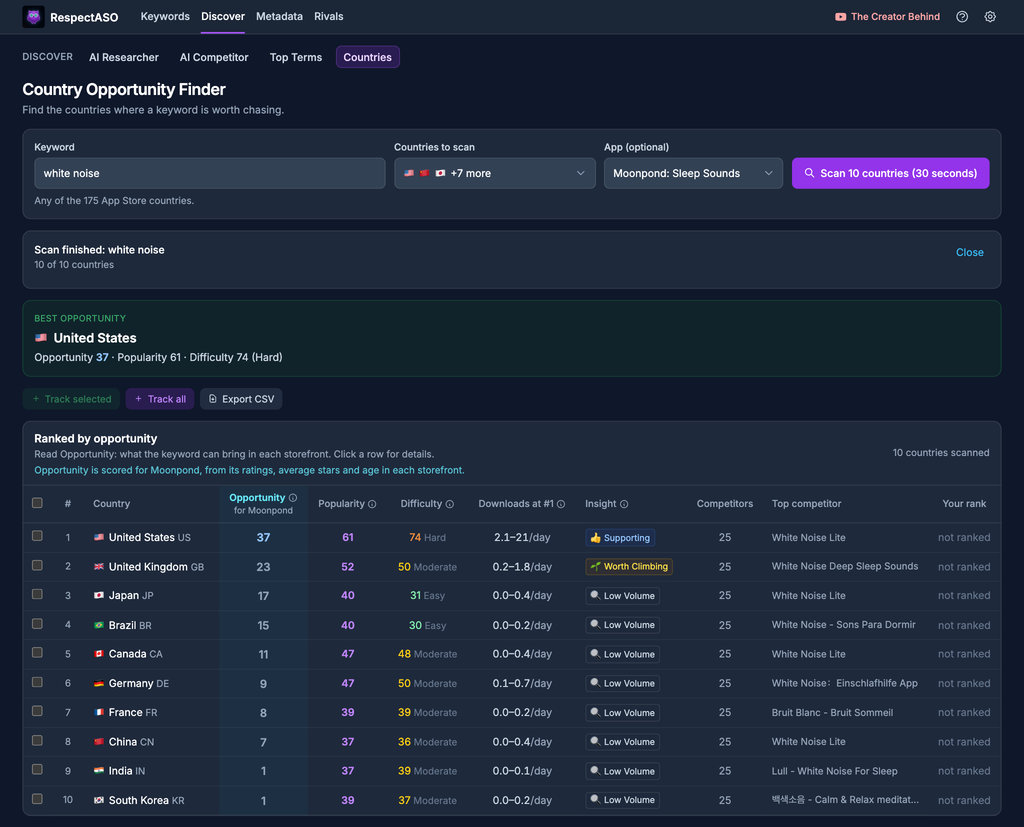
RespectASO's Country Opportunity Finder ranks the storefronts you pick for any keyword
Find the Best Keywords for Spain
See which keywords your app can win in the Spain App Store: RespectASO scores the popularity and difficulty of any keyword there, free on your Mac.